
Reviewed · SHORE EXCURSIONS
Shore Excursion from Salaverry port
Ancient adobe cities make a memorable port day. This five-hour excursion links Trujillo’s most important archaeological sites, with Huaca de la Luna’s painted reliefs and Moche story followed by the vast ruins of Chan Chan. I like the amount covered for $80, and I like having round-trip transport from Salaverry port rather than arranging several taxis in an unfamiliar area.
The main caution is timing. The published details give both an 8:00 am meeting time and a 9:15 am tour departure, while cruise arrivals can shift the schedule. Entrance fees are also extra, and past departures have sometimes felt rushed when the start was late. Keep your phone on and check messages before leaving the ship.
In This Review
- Key points before you book
- Why these ruins matter more than a quick photo stop
- Huacas del Sol y de la Luna: the Moche beginning
- The Huacas de Moche Museum adds the missing details
- Huaca Arcos Iris and the story of Takaynamo
- Chan Chan: the day’s biggest archaeological payoff
- Transport, timing, and the cruise-port risk
- What the $80 price really covers
- Guide quality is the key variable
- Walking, weather, and what to bring
- Should you book this Salaverry shore excursion?
- FAQ
- Where does the tour start and finish?
- How long does the excursion last?
- What time does the tour start?
- Can the tour time change if my ship arrives late?
- Are entrance fees included?
- Is food included?
- How many people can join the tour?
Key points before you book
- Three major archaeological stops: See the Moche Huacas del Sol y de la Luna, the Chimú Rainbow Temple, and Chan Chan in one outing.
- Strong value for a port day: At $80 per person, the tour covers transport, guiding, and several sites that would take effort to arrange independently.
- Expect additional admission costs: Entrance fees are not included, and the amount collected has varied in past departures.
- A guide can make or break the day: Alfredo receives especially warm praise for clear, detailed explanations, though English quality may vary by departure.
- Allow for a busy schedule: The advertised duration is about five hours, but changes, delays, or an added lunch stop have made some outings longer.
- Prepare for heat and walking: Bring water, a hat, sunscreen, and shoes that handle uneven ground and steps.
Why these ruins matter more than a quick photo stop
The Trujillo area is one of Peru’s best places to see the remains of cultures that flourished long before the Inca. Here, the Moche and Chimú built large ceremonial centers from adobe, shaped political power around temples and palaces, and left behind artwork that still gives you clues about daily life and ritual.
That matters on a short cruise excursion. You are not simply ticking off three ruins. You are watching one ancient culture give way to another, first at the Moche temples, then at a Chimú religious site, and finally at the enormous Chimú capital of Chan Chan.
The tour uses a small-group vehicle, with a maximum of 23 people. That is not an intimate private tour, but it is more manageable than a large cruise bus. A good guide can keep the history moving while you walk between platforms, courtyards, and adobe walls.
The average booking lead time is about 69 days, which suggests that cruise passengers often reserve this well ahead of their sailing. If you want this particular port-day plan, booking early is sensible, especially when your ship offers only one day in Salaverry.
A few more Trujillo trips worth lining up side by side
- Trujillo Shore Excursion from Salaverry Port
★ 5.0 · 9 reviews - Shore Excursion from Salaverry port
★ 4.5 · 8 reviews - Shore Excursion: 2-Day The Best of Lima from Callao Port
★ 5.0 · 21 reviews
Huacas del Sol y de la Luna: the Moche beginning
The first major stop is the Huacas del Sol y de la Luna, also called the Temples of the Sun and Moon. These enormous adobe structures belonged to the Moche, whose empire developed in northern Peru centuries before the Chimú.
Huaca de la Luna served as a religious complex. Huaca del Sol functioned as an administrative center. Together, they show that Moche society was organized around both ceremony and government, not just isolated temple building.
The most interesting detail is how the temples grew. The Moche did not simply repair one old structure. Over roughly 700 years, they sealed the remains of rulers inside a completed platform, then covered it with a new platform and built again above it. The result became a huge stepped pyramid, built layer by layer across generations.
That method gives the site a strange, powerful character. You can think of it as an archaeological record in stacked chapters. Each new building concealed the earlier one, preserving parts of the past inside the later structure.
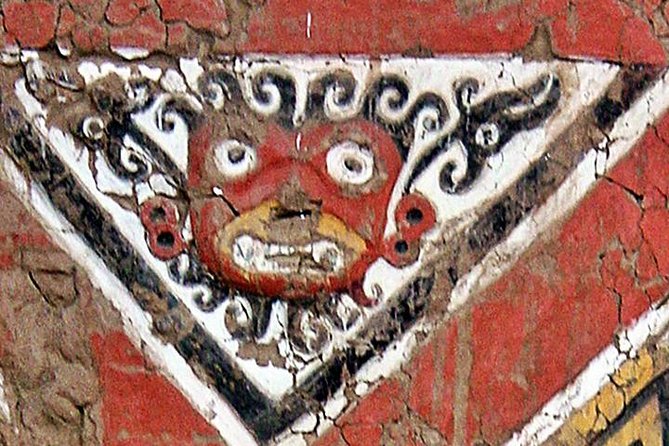
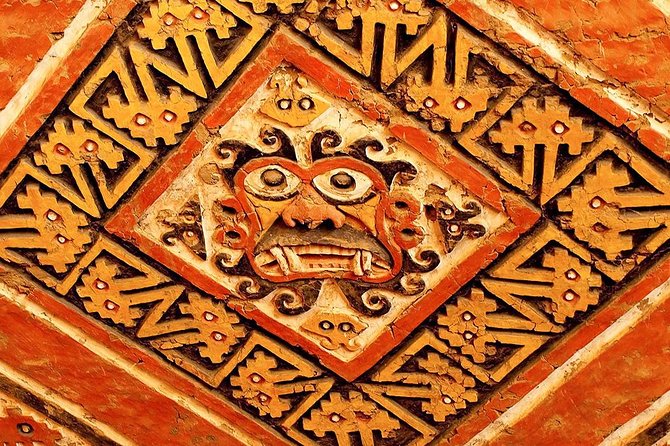
Huaca de la Luna is usually the more visually rewarding of the two. The temple is known for adobe decoration and painted surfaces, including images connected with Moche religious life. The colors and designs are especially striking because they survive on walls made from humble mud brick.
Your guide’s explanation matters here. Without context, a wall of adobe can look like a damaged mound. With a clear account of Moche rulers, ceremonies, burial practices, and temple construction, the site becomes easier to read. Several strong outings have featured guides who answered detailed questions and explained both artifacts and historical records.
There is walking at this stop, including uneven surfaces and steps. One past group found the amount of walking tiring, so do not treat this as a sit-back-and-watch excursion. If you move slowly, stay near the guide and make sure the group understands your pace before setting out.
The Huacas de Moche Museum adds the missing details
The nearby Huacas de Moche Museum houses ceramics, utensils, artifacts, and tombs connected with the site. This is an important part of the visit because the museum gives you the small-scale evidence that the giant temple cannot.
At the huaca, you see construction and painted walls. In the museum, you see objects that help explain how people lived, worked, worshiped, and buried their dead. Ceramics can reveal much about Moche artistic skill and religious images, while everyday tools make the culture feel less distant.
Time may be limited, especially if the group leaves Salaverry late. If you have to choose where to focus, listen closely to the guide’s explanation of the museum objects rather than trying to race through every display. The value here comes from connecting the objects to the temple outside.
Huaca Arcos Iris and the story of Takaynamo
The tour then moves to Huaca Arcos Iris, also known as the Rainbow Temple or El Dragon. This site was built by the Chimú around A.D. 1200, placing it after the main Moche period.
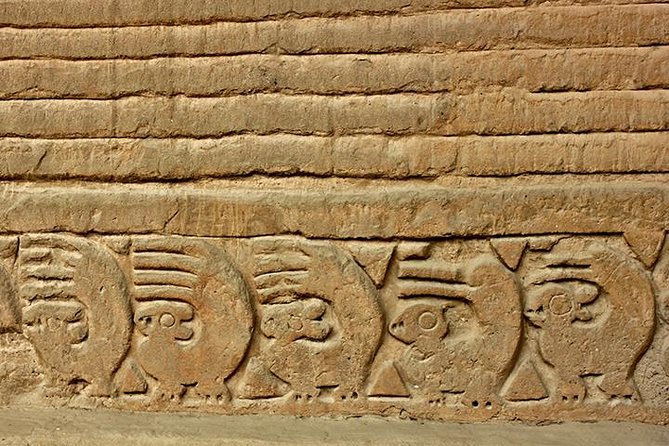
The temple has two platforms, carved adobe panels, and niches that once held ritual objects. Compared with Chan Chan, it is a smaller stop, but it helps you understand Chimú design before you reach their great capital.
Local tradition identifies Huaca Arcos Iris with Takaynamo, the mythical founder of Chan Chan. That story gives the stop a useful narrative link. You are not visiting a disconnected mound, then suddenly arriving at a city. You are following the cultural thread from temple traditions to the center of Chimú power.
The carved panels are vulnerable, and the experience depends partly on how much of the decoration is open and visible on the day. Local closures or weather conditions can lead to changes, so keep your expectations flexible. The operator may adjust the route when a site is unavailable, and one past outing replaced planned stops and added lunch, extending the day by about two hours.
Also leaving from Trujillo, and nothing like the above:
- Full Day Trujillo Piramides Sol y Luna , Chan chan y Huanchaco
★ 5.0 · 93 reviews - Full Day Tour Huacas, Chan Chan & Huanchaco – Trujillo
★ 4.5 · 64 reviews - Customize Cruise Ship Full Day tour – English Guide
★ 4.5 · 42 reviews - Full Archaeological Chan Chan Tour
★ 5.0 · 30 reviews
Chan Chan: the day’s biggest archaeological payoff
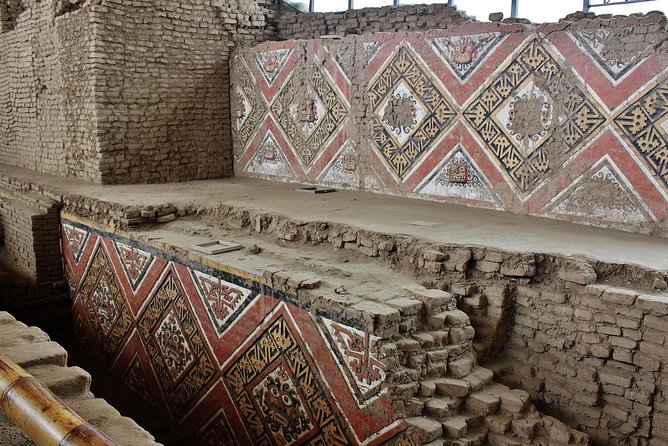
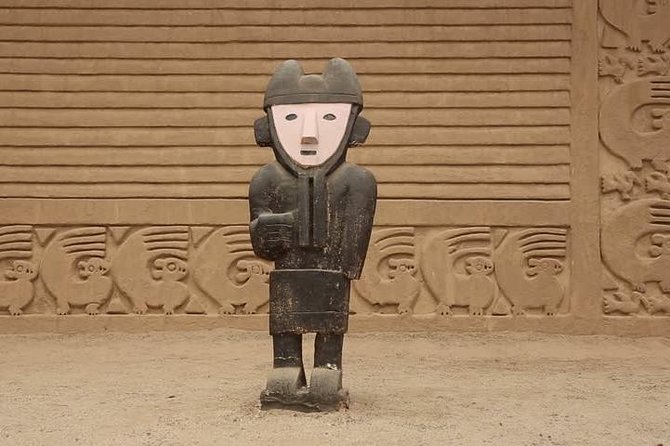
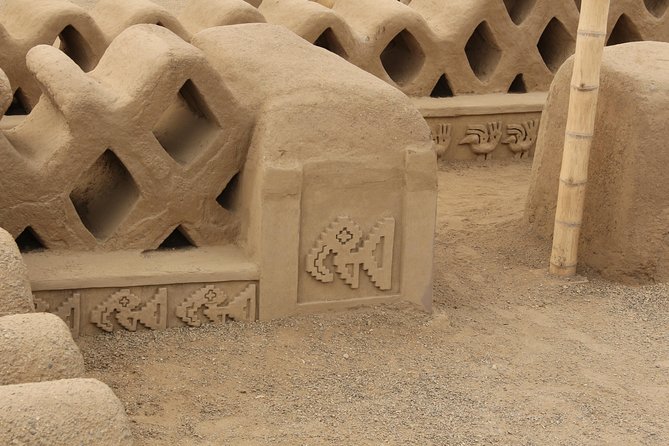
Chan Chan is the grand finale, and for many people it is the strongest stop. It was the capital of the Chimú empire and is recognized as a UNESCO World Heritage Site. It is also the largest pre-Columbian adobe city in the Americas.
The scale is hard to grasp from a single photograph. Chan Chan once included courtyards, terraces, palaces, and gardens, with an estimated population of 30,000 to 60,000 people. This was not merely a temple complex. It was a functioning city with social order, ceremony, and daily work spread across a huge adobe settlement.
The surviving walls carry carved designs and geometric forms associated with Chimú art. As you move through the ruins, the city plan becomes the story. Open spaces suggest formal gathering areas, while palace compounds and enclosed sections hint at the separation between rulers, officials, artisans, and ordinary residents.
A guide who can explain what you are seeing adds real value here. Chan Chan is extensive, and without interpretation, you may notice walls but miss the purpose of the spaces. Several well-regarded guides, including Alfredo, have been praised for explaining the culture, history, and archaeological features in a way that makes the ruins easier to understand.
Do not expect a leisurely wander through every corner. The tour is designed to cover several sites in a single port call. Some groups have felt rushed, especially after a late start. If Chan Chan is your main reason for booking, ask at the beginning how much time is planned there and stay aware of the meeting point.
Transport, timing, and the cruise-port risk
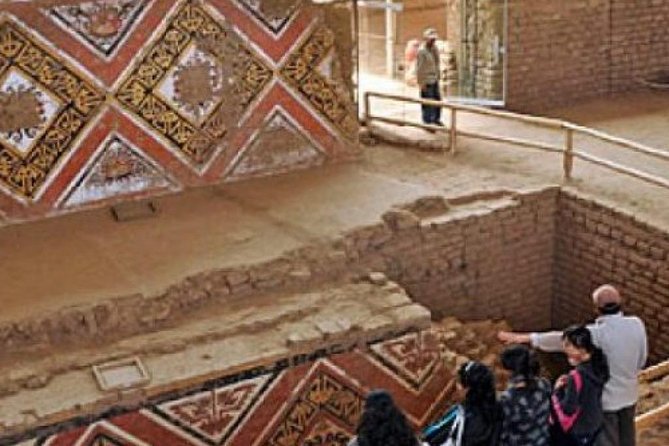
The tour includes pickup and return at Salaverry port, which is its biggest practical advantage. You do not need to negotiate with drivers, find separate transport to Trujillo, or work out how to return to the ship after visiting several sites.
The stated tour start needs careful checking. One part of the information says the excursion begins at 9:15 am, while the meeting details list 8:00 am. A past group missed part of the outing after the vehicle left earlier than expected, and the passengers did not receive the change because they had no phone service.
For that reason, check email, WhatsApp, and the booking message before the port day. Keep your mobile phone switched on, and if your ship has no cellular service, ask the ship’s guest services desk to help confirm the meeting plan. Do not rely only on the original time shown when you booked.
The operator says the schedule can move if your ship arrives at 10:00 or 11:00 am, with the return planned around the ship’s departure. That flexibility is useful, but it is still wise to confirm the revised pickup time in writing.
The vehicle has been described as comfortable, but boarding steps can be steep. You may get on and off several times during the day, so this is not the best choice if you have serious difficulty with bus steps, uneven paths, or extended walking. Most people can participate, but the physical demands should be taken seriously.
What the $80 price really covers
At $80 per person, this is a solid value if you want all three archaeological areas in one organized outing. Transport from and back to the port is included, as is an English or Spanish-speaking guide. A private taxi plan could offer more control, but it would require arranging site transport, timing, and admission on your own.
The price does not include food, drinks, personal insurance, or entrance fees. This is the point most likely to cause frustration. Past departures have collected extra amounts ranging from about $8 to $15, while another group was asked for $10. The exact charge may depend on the sites open and the local admission arrangement, so ask for the current total before you board.
Bring enough Peruvian currency or another accepted payment method for admissions and personal purchases. You should also bring money for a possible meal if the route changes. Lunch was not part of the stated plan, but one altered outing included a restaurant stop.
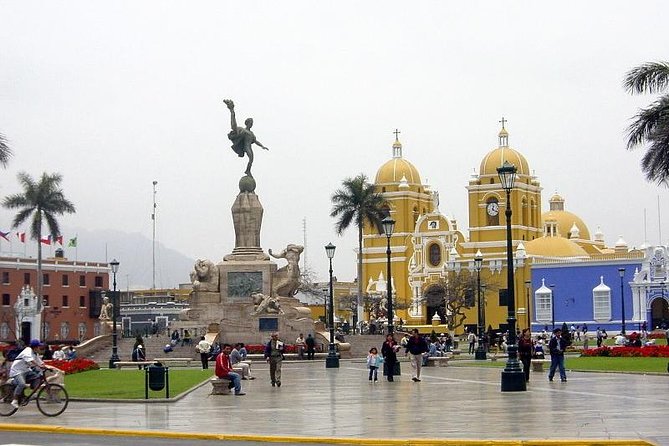
When you add admission fees, the final cost is higher than the headline price. Even so, the package remains attractive for cruise passengers who value convenience and want a guide at each archaeological site. The value drops if you mainly want free time, a slow lunch, or a flexible visit to Trujillo’s central plaza.
Guide quality is the key variable
The strongest part of this excursion is often the guide. Alfredo is singled out for detailed explanations, cultural knowledge, and an ability to answer questions. Other well-received departures also had guides who gave clear historical background and communicated well at each stop.
The experience is less successful when the guide’s English is difficult to understand or when the vehicle microphone garbles the commentary. One group felt the guide walked ahead and spoke mainly to the people who kept up, leaving others without enough explanation.
You can improve your chances by staying close to the guide, asking for repetition when the sound system fails, and speaking up if the group is spreading out. If English is important to you, confirm that an English-speaking guide is assigned. Spanish is also offered.
The tour is not a silent transfer between ruins. You are paying partly for interpretation, so it is fair to expect useful commentary while driving too. Some outings had excellent explanations at the sites but less narration on the road.
Walking, weather, and what to bring
Northern Peru can be hot and exposed. Pack a hat, sunscreen, and plenty of water. These are not decorative extras, especially when you are walking around adobe ruins with limited shade.
Wear sturdy shoes. The route includes archaeological ground, platforms, paths, and steps. A past group also encountered a long, muddy path during an unexpected restaurant stop, so practical footwear is safer than sandals with thin soles.
The outing may suit active couples, friends, and amateur history fans especially well. It is also a good match for anyone who wants a broad introduction to the Trujillo area during one cruise stop.
You may want a different plan if you dislike structured sightseeing or need a slow pace. Several stops, repeated vehicle boarding, and a fixed ship-day schedule can feel tiring. The group limit of 23 helps, but it does not turn the excursion into a private visit.
Should you book this Salaverry shore excursion?
I would book it if your priority is seeing the major Moche and Chimú sites without worrying about transport. Chan Chan and Huaca de la Luna are the main reasons to go, and the combination gives you far more historical context than visiting one ruin alone.
Before paying, confirm four things: the exact pickup time, the current entrance fee, the assigned language guide, and the expected return time to the ship. Keep your phone on for schedule updates, bring cash for admissions, and leave room in your day for delays.
This is a good-value archaeology tour, but not a perfectly controlled one. Choose it for its strong route, port pickup, and potential for excellent guiding. Skip it if you need guaranteed free time, dislike walking, or cannot manage last-minute schedule changes.
FAQ
Where does the tour start and finish?
It starts at Salaverry Port and ends back at the same meeting point, allowing you to return to your ship from the port.
How long does the excursion last?
The planned duration is approximately five hours. Actual timing can change because of late starts, site closures, traffic, or an added meal stop.
What time does the tour start?
The information gives both 8:00 am as the meeting time and 9:15 am as the tour departure. Confirm the exact pickup time before the port day, since departures may be adjusted.
Can the tour time change if my ship arrives late?
Yes. If your ship arrives at 10:00 or 11:00 am, the operator says the tour time can be moved forward and the return arranged around the ship schedule.
Are entrance fees included?
No. Admission fees are excluded from the tour price. Past departures have collected different additional amounts, so ask for the current cost before leaving the port.
Is food included?
No. Food and drinks are not included. A meal stop has been added during at least one changed itinerary, so carrying money for food is sensible.
How many people can join the tour?
The maximum group size is 23 people. Transportation is provided in a small-group vehicle.
Added recently around Trujillo
- Trujillo Shore Excursion from Salaverry Port★ 5.0 · 9 reviews
- Full Day in Trujillo from Puerto Salaverry★ 5.0 · 22 reviews
- El Brujo Archaeological Site & Lady of Cao Complex from Trujillo★ 4.0 · 5 reviews
- El Brujo – Archeological site & Museum★ 4.5 · 11 reviews
- Trujillo Private★ 4.0 · 4 reviews
- Trujillo in a Day: Chan Chan, Huanchaco, Sun and Moon Temples★ 4.5 · 16 reviews
- Full Day Group shore excursions Tours from salaverry port★ 5.0 · 13 reviews
- Shore Excursion from Salaverry port★ 4.5 · 8 reviews
Shore Excursions, compared.
Shore Excursion: 2-Day The Best of Lima from Callao Port
Read our review →
Shore Excursion: Pachacamac, Lunch & City Tour From Callao Port
Read our review →
Privated Shore Excursion From Salaverry Port – Trujillo Full Day
Read our review →
Shore excursion from the Port of Callao for Cruises
Read our review →
Browse the lists this tour appears in