
Reviewed · LUNCH EXPERIENCES
Awamaki Earth-Oven Lunch Package
The best souvenirs are often handmade. Awamaki’s Earth-Oven Lunch brings you into a Quechua village above Ollantaytambo, where you can learn traditional wool work and share a home-cooked pachamanca meal. I like the direct connection with local women and the way your $130 fee supports an ethical craft program. I also like that transport, an interpreter, lunch, and hands-on instruction are included.
The main drawback is the start point: you must reach Ollantaytambo on your own. The high mountain setting also means changeable weather, so bring layers and rain protection. This is a half-day cultural outing, not a quick photo stop, and the road into the Patacancha Valley takes time.
In This Review
- Key points to know before booking
- Why this half-day experience feels different
- Starting at Ollantaytambo’s plaza and Awamaki Store
- Riding up the Patacancha Valley
- Meeting the Quechua weavers in the mountain community
- Sharing a pachamanca lunch
- Buying textiles directly from the makers
- What the $130 price really covers
- Transport planning from Cusco and Urubamba
- Who should book this Andean lunch
- Final verdict: book it for people, craft, and food
- FAQ
- How long does the Awamaki Earth-Oven Lunch last?
- What time does the tour begin?
- Where does the tour start?
- Is transportation from Cusco included?
- Is transportation from Ollantaytambo included?
- What food is included?
- Can dietary restrictions be accommodated?
- What should I bring?
- How many people can join the tour?
Key points to know before booking
- A working Quechua craft tradition: Learn how alpaca or sheep wool is spun, dyed, and woven into useful textiles.
- Pachamanca lunch included: Food is cooked in an Andean earth oven, giving the meal a strong sense of place.
- A scenic ride into the Patacancha Valley: The route passes terraces, Inca ruins, farms, villages, and the Patacancha River.
- Small-group format: The maximum group size is 15 people, which allows more personal help during the craft lesson.
- Ollantaytambo is your transport hub: Pickup and return are provided there, but transport from Cusco or Urubamba is not included.
Why this half-day experience feels different
Many Sacred Valley outings show you remarkable ruins and let you take photographs. This one asks you to slow down and spend time with a community. You are not simply looking at a finished textile in a shop. You see some of the work behind it, try a small part of the process, and eat a meal prepared in the local style.
That difference matters. Weaving here is not presented as a museum display. The women you meet use skills passed through Quechua communities, and the textiles carry symbols connected to Andean life, animals, and beliefs. You will not become a master weaver in a few hours, but you will leave with a better sense of the patience and handwork each item requires.
The program is organized through Awamaki, whose store in Ollantaytambo sells Andean crafts made with a contemporary style. The store visit gives you a useful introduction before heading farther into the mountains, and it gives you a chance to buy directly connected craftwork later in the day.
I especially value the social purpose here. The program supports women who are building income through their weaving business. That does not make the experience automatically perfect, but it gives your purchase and participation a clearer purpose than buying an anonymous souvenir from a market stall.
A few more Cusco trips worth lining up side by side
- Classic Inca Trail Trek 4D/3N to Machu Picchu (Group Service)
★ 5.0 · 8,653 reviews - Cusco: Rainbow Mountain and Red Valley Day Trip with Meals
★ 4.9 · 4,893 reviews - Machu Picchu: 4-Day Inca Trail Trek with Panoramic Train Ride
★ 5.0 · 4,568 reviews
Starting at Ollantaytambo’s plaza and Awamaki Store
The day begins at 9:00 a.m. at La Esquin, near Ollantaytambo’s main plaza. From there, the outing includes a visit to the Awamaki store on Calle Principal, just off the plaza and beneath the main ruins.
Allow about 30 minutes for this stop. You can see finished pieces with a modern look while learning more about the kind of work made by Andean artisans. This is also a practical place to get familiar with the organization before meeting the weavers in their own community.
The store may feel less personal than the village visit, since the finished goods are already displayed and ready for sale. Still, it adds useful context. Once you see a completed runner, cushion cover, bracelet, or keyring, the later demonstrations make more sense.
If you plan to purchase textiles, carry local money in small bills. The suggested range is 5 to 500 soles, but small notes are best because the women may not be able to make change. Buying directly from the weavers is one of the most meaningful parts of the day, so it is wise to decide in advance how much you want to spend.
Riding up the Patacancha Valley
The drive into the Patacancha Valley takes about an hour and a half, including stops at ruins and other points of interest. This is not dead time between activities. The road climbs beside the Patacancha River, with ancient terraces, small farms, villages, and Inca remains along the way.
You will see how people have used these steep mountain slopes for generations. The terraces are not simply scenic backdrops. They show the practical skill needed to farm in the Andes, where altitude and uneven ground shape daily life.
The route also gives you a gradual change in setting. Ollantaytambo is already high by most standards, but the village community sits farther into the mountains. Bring sunscreen, water, and warm clothing in layers. Conditions can shift quickly, and a rain jacket is a sensible addition even if the morning begins clear.
The drive may be tiring for anyone who dislikes winding mountain roads or has limited time in the Sacred Valley. The total outing lasts about four to six hours, so it occupies a substantial part of your day. In exchange, you get a setting that feels far removed from the main tourist route.
Meeting the Quechua weavers in the mountain community
At the community, your English-speaking guide and interpreter help bridge the language gap. Past guides have included Célestine, Melissa, and Eleanor, all praised for helping visitors understand the social and cultural details as well as the practical craft work.
That interpreter role is important. Without it, you might see a spinning demonstration without understanding what the steps mean or how the work fits into local life. A good guide turns the meeting into a conversation rather than a performance.
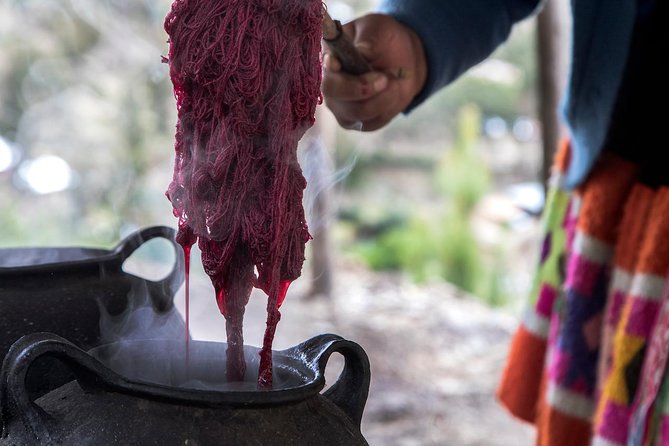
The women explain and demonstrate traditional yarn spinning, using alpaca or sheep wool. You may see how raw wool is prepared, spun, and dyed before it becomes woven cloth. The process is surprisingly complex, especially when you consider that the final design may communicate elements of Andean culture through color and symbols.
You also get a hands-on weaving lesson. Each person may work with a local teacher to make a small bracelet, known locally as a pulsera. This is a modest project, but it gives you a quick lesson in how much concentration goes into even a simple band.
Do not expect a polished craft class with identical materials and finished results. The point is to learn from people who use these techniques as part of their work. Your bracelet may be uneven, which is part of the fun. You will understand the craft better after trying it yourself.
Also leaving from Cusco, and nothing like the above:
- Salkantay Classic Trek 5 Days from Cusco
★ 5.0 · 4,062 reviews - 4-Day Salkantay Trek with Sky Camp Stay
★ 5.0 · 3,346 reviews - Short Inca Trail to Machu Picchu 2D/1N
★ 5.0 · 3,007 reviews - Excursion to Rainbow Mountain Full Day Optional Red Valley
★ 5.0 · 2,996 reviews
Sharing a pachamanca lunch
The meal is one of the strongest parts of the experience. The community prepares lunch in a pachamanca, an Andean earth oven. Food is placed underground with heated stones, then covered while it cooks.
The method connects the meal to the land and to older Andean cooking practices. More importantly, you eat together in the community rather than stopping at a standard restaurant. Several people describe the meal as one of the best they had in Peru, which is high praise in a country with an excellent food culture.
The experience lasts long enough for the meal to feel social, not rushed. You can ask questions through the interpreter, watch the preparation, and talk with the women before or after the weaving lesson.
Dietary restrictions can usually be accommodated, but you must note them in the special instructions when booking. The operator says it can handle nearly all dietary needs and will contact you if a request cannot be met. Do not leave this until the morning of the tour.
Buying textiles directly from the makers
After the lesson and lunch, you have an opportunity to see and buy handmade goods. Items may include bracelets, keyrings, cushion covers, and table runners, along with other woven pieces.
This is a good place to buy if you want a souvenir with a clear origin. You have seen some of the skill involved, met the people connected to the cooperative, and can ask questions through the guide. Prices are described as reasonable, but you should still choose pieces because you genuinely like them rather than treating the purchase as a charitable donation.
Carry small bills in soles. The practical reason is simple: change may not be available in a remote community. You can also avoid the awkwardness of trying to negotiate a large note after you have found something special.
The shopping portion should not feel like the main purpose of the outing. The craft lesson and shared meal come first. The purchases are a useful final step because they let the women benefit directly from their work.
What the $130 price really covers
At $130 per person, this is not the cheapest half-day activity around Ollantaytambo. You are paying for more than transport to a viewpoint, though. The fee includes a guide and interpreter, round-trip transportation from Ollantaytambo, the craft demonstrations, a weaving lesson, and lunch.
The cost also helps support a community-based program rather than only covering sightseeing overhead. That makes the price easier to justify for anyone who values responsible tourism and direct support for local women.
Still, value depends on what you want from Peru. If you mainly want ruins, dramatic photographs, or a packed schedule, a standard Sacred Valley tour may offer more stops for less money. If you want time with a community, a chance to try a traditional craft, and a meal prepared in an earth oven, this outing offers something those tours usually cannot.
The group limit of 15 is another positive. A smaller group makes it easier to hear the interpreter and receive help with weaving. It also reduces the chance that the community meeting feels like a large procession moving through someone’s home.
The duration varies from four to six hours. Build in room around the appointment rather than scheduling a tight connection afterward. The return is to Ollantaytambo, and the experience can be especially convenient if you are already staying there or passing through on a Sacred Valley itinerary.
Transport planning from Cusco and Urubamba
Transport to Ollantaytambo is not included from Cusco, Urubamba, or other towns. Your hotel in Cusco can arrange the trip to Ollantaytambo, but Awamaki does not arrange that outbound leg.
This is the biggest planning point. You need to reach the 9:00 a.m. meeting point on time, so a same-morning journey from Cusco requires careful planning. If you are already in Ollantaytambo, the logistics are much easier.
The operator can help arrange transportation from Ollantaytambo back to Cusco after the tour if you ask your guide. It can also carry luggage if you are in transit or store bags securely at its office. Those options make the outing more useful on a moving day, though you should arrange details ahead of time.
The meeting information lists the end point at the Awamaki Store on Calle Principal. Confirm the exact return arrangement with the operator, especially if you are connecting to a train, hotel transfer, or long-distance ride.
Who should book this Andean lunch
I would choose this experience if you want cultural contact with some structure around it. You do not need prior weaving experience. Most people can participate, and service animals are allowed.
It suits adults, families with older children, and anyone who enjoys learning by doing. The weaving activity is approachable, while the mountain drive and village visit give the day enough variety to hold your attention.
It is also a strong choice for visitors who want to spend money in a more responsible way. The social mission is central to the experience, not an afterthought. You can meet the women, learn from them, and buy their work directly.
I would think twice if you have only one short day in the Sacred Valley and want to see every major archaeological site. The drive takes time, and this is not a rapid-fire sightseeing tour. It also may not suit anyone who needs a highly predictable schedule or dislikes changing mountain weather.
The tour is generally accessible to most people, but the information does not provide detailed mobility specifications. If you have specific access needs, contact the operator before booking. Special requests are usually possible, and dietary needs should be stated in advance.
Final verdict: book it for people, craft, and food
I recommend the Awamaki Earth-Oven Lunch if you want an ethical, personal experience in the Sacred Valley. The strongest elements are the women’s weaving instruction, the interpreter’s role, the pachamanca meal, and the chance to buy directly from the makers.
Book it when you can spare half a day and reach Ollantaytambo without stress. Skip it if you want a bargain sightseeing loop or cannot manage the early meeting point and mountain drive.
For the right kind of itinerary, this is a memorable choice. You return with more than a bracelet or textile. You understand who made it, how it was made, and why that work matters.
FAQ
How long does the Awamaki Earth-Oven Lunch last?
The experience lasts approximately four to six hours, depending on the day’s route and activities.
What time does the tour begin?
The scheduled start time is 9:00 a.m.
Where does the tour start?
It starts at La Esquin near the Plaza de Armas in Ollantaytambo, Peru.
Is transportation from Cusco included?
No. Transportation to Ollantaytambo from Cusco, Urubamba, or another city is not included.
Is transportation from Ollantaytambo included?
Yes. Round-trip transportation from Ollantaytambo is included. The operator may also help arrange transport from Ollantaytambo back to Cusco after the tour.
What food is included?
A home-cooked lunch is included. The community prepares the meal in a pachamanca, or Andean earth oven.
Can dietary restrictions be accommodated?
Most dietary restrictions can be accommodated. You should add your dietary needs to the special instructions when booking.
What should I bring?
Bring water, sunscreen, warm layers, a rain jacket, comfortable shoes, a camera, and local currency in small bills if you want to buy textiles.
How many people can join the tour?
The maximum group size is 15 people.
Added recently around Cusco
- Guided tour of the mountain of colors in Cusco★ 5.0 · 11 reviews
- 2-Day Private Short Inca Trail to Machu Picchu★ 5.0 · 15 reviews
- City Tour Cusco – Group★ 5.0 · 4 reviews
- Tour Sacred Valley with Maras and Moray★ 5.0 · 15 reviews
- San Pedro Market Tour with Peruvian Cooking Class★ 5.0 · 31 reviews
- Walking Culinary Experience★ 5.0 · 41 reviews
- City Tour in Cusco★ 4.5 · 10 reviews
- One Day Tour to Humantay Lagoon★ 5.0 · 8 reviews
Lunch Experiences, compared.
Humantay Lake Tour with Breakfast and Buffet Lunch
Read our review →
Sacred Valley & Maras Salt Mines Tour with Lunch
Read our review →
Machu Picchu: Full-Day Tour from Cusco with Optional Lunch
Read our review →
Humantay Lake Full Day Trek from Cusco with Lunch
Read our review →
Sacred Valley and Maras Moray Tour with Full Day Buffet Lunch
Read our review →
Sacred Valley: Chinchero, Moray, Ollantaytambo & Pisac+Lunch
Read our review →
Tour Sacred Valley & Maras – Moray with buffet lunch
Read our review →
Pisac Indian Market and Ollantaytambo Fortress with Lunch
Read our review →Browse the lists this tour appears in