
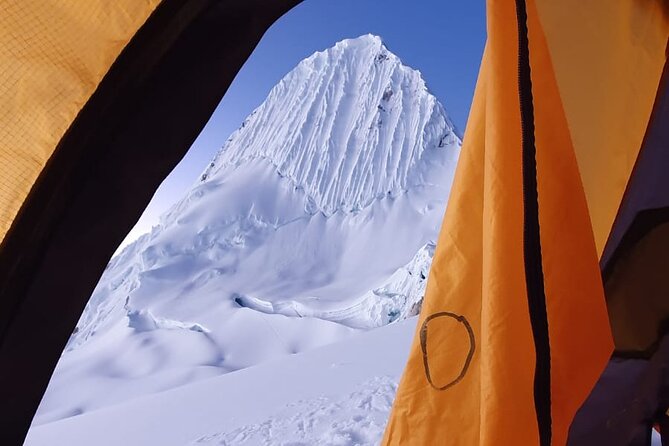
Reviewed · ANDEAN TREKKING TOURS
20Day-Santa Cruz Trek Peak Alpamayo 5957 m and Chopicalqui 6354 m
The Andes save their biggest tests for later. This 20-day expedition combines the Santa Cruz Trek with serious climbing on Alpamayo at 5,957 meters and Chopicalqui at 6,354 meters, using Huaraz as its base. You begin with gentle acclimatization walks, then move into glacier travel, high camps, crevasses, steep ice, and long summit days.
I like the careful buildup from Laguna Wilcacocha and Laguna Churup to higher mountain camps. I also like the strong support system: a UIAGM-certified high-mountain guide for every two clients, a cook, porters, donkeys, private transport, and organized base camps. The main consideration is simple: this is not a sightseeing trek with a little climbing added. You need a high level of fitness, mountaineering experience, personal equipment, and comfort with long, technical days.
The price is $3,960 per person, which is substantial, but it covers 20 days of transport, hotels, meals on the trail, permits, staff, and two major peaks. The package offers real value for climbers who need a full logistical team, though the cost does not include climbing gear, insurance, tips, city meals, or extra nights caused by delays.
In This Review
- Five details that shape the experience
- Starting in Lima and climbing toward Huaraz
- Wilcacocha and Churup: acclimatization with a view
- Contrahierbas and the move into the Santa Cruz valley
- Punta Union and Alpamayo Base Camp
- Alpamayo High Camp and the French Route
- A necessary reset in Huaraz
- Chopicalqui Base Camp and glacier camps
- Chopicalqui summit day at 6,354 meters
- What the $3,960 price really covers
- Who should book this expedition?
- Should you book Alpamayo and Chopicalqui?
- FAQ
- How long does the Alpamayo and Chopicalqui experience last?
- Where does the experience begin?
- What is the price per person?
- Are hotels included?
- Are meals included?
- Is climbing equipment included?
- Can I cancel for a full refund?
Five details that shape the experience
- Alpamayo and Chopicalqui provide two very different tests: Alpamayo involves steep ice, while Chopicalqui adds crevasses, seracs, and technical glacier sections.
- Acclimatization is built into the first five days: Wilcacocha, Churup, and Contrahierbas help your body adjust before the Santa Cruz route.
- The Santa Cruz crossing is more than a warm-up: Punta Union reaches high altitude and gives you a clear view of the route ahead.
- Guide coverage is unusually strong: The advertised ratio is one UIAGM-certified high-mountain guide for every two clients.
- The support team carries much of the expedition load: Porters, cooks, donkeys, and donkey drivers handle camp and food logistics.
- You need your own technical kit: Boots, crampons, ice axe, harness, sleeping bag, mat, Gore-Tex clothing, and related equipment are not included.
Starting in Lima and climbing toward Huaraz
Your first day is deliberately easy. You arrive in Lima, stay at the three-star Hotel Kamana in the central area, and have time to rest or explore independently. With a population of roughly 11 million, Lima can be tiring after an international flight, so keeping this day light makes sense.
On Day 2, you travel north by bus along the Pan-American Highway and then turn inland toward the mountains. The ride takes about eight hours and crosses the coastal desert before reaching Conococha Pass at 4,020 meters. From there, the road drops toward the Santa Valley and Huaraz, at about 3,100 meters.
You can also fly between Lima and Huaraz in about 50 minutes using LATAM-Peru on the way up, and LC-Peru is listed for the return. The bus is slower but gives you a clear sense of Peru’s dramatic change from dry coast to high Andes. The flight saves time, but schedules and luggage arrangements deserve confirmation before booking.
In Huaraz, accommodation is at Hotel Valery, Hotel Rubi, or a similar three-star property. The exact hotel can vary, so I would confirm the final name and location before departure.
More Hiking Tours in Huaraz
- From Huaraz: Hike to the Lagoon 69
★ 4.4 · 121 reviews - Santa Cruz 4 Days Trek
★ 4.5 · 14 reviews - Trekking to Laguna 69
★ 4.0 · 12 reviews
Wilcacocha and Churup: acclimatization with a view
Day 3 takes you to Laguna Wilcacocha in the Cordillera Negra. This lake is valuable not because it is the hardest walk, but because it gives you an excellent viewing platform across the Santa Valley. From here, you can identify major peaks including Huandoy, Huascarán, Chopicalqui, Hualcán, Copa, Vallunaraju, Ocshapalca, Ranrapalca, Palcaraju, and Churup.
The chance to see wild ducks at the lake adds a small natural touch to the outing. More important, you begin learning to move at altitude without spending the day under expedition pressure. You return to Huaraz for the night.
Day 4 brings a tougher acclimatization hike to Laguna Churup. The route begins near Llupa and follows an old Inca trail. It becomes narrow and steep, with a short section using fixed ropes. That detail matters: even before you reach the glacier, you are getting a feel for exposed terrain and hands-on movement.
Churup Lake sits below the rocky, glaciated Churup Peak, which rises to about 5,400 meters. The program allows time to continue toward the Churup summit trail and make a loop before returning, depending on conditions and the group’s strength. This is a beautiful outing, but it should not be treated as a casual walk. Your legs and lungs are already being tested.
Contrahierbas and the move into the Santa Cruz valley
Day 5 is a long day, listed at about ten hours, involving Contrahierbas and Mateo’s summit. The mountain is described as accessible and popular with people preparing for higher climbs. From the summit area, you can see Huascarán, Chopicalqui, Ulta, Contrahierbas, and other high peaks.
This is useful preparation because the next day shifts from hotel-based acclimatization to a proper multi-day mountain journey. You should expect a demanding schedule even before reaching the technical climbing.
On Day 6, a minibus carries you north through the Santa Valley and past Yungay. You cross Portachuelo Pass at 4,650 meters before descending to Vaqueria at 3,750 meters, where pack animals and their drivers are waiting.
The walking begins with a short route to Huaripampa at 3,550 meters, then continues up the valley past Paria at about 3,800 meters to Amapampa camp at 4,250 meters. The combination of vehicle travel, a high pass, and an eight-hour mountain day makes this a full start to the trek. The donkeys are not a minor convenience here. They reduce the load you must carry and allow the group to bring proper camp supplies.
Punta Union and Alpamayo Base Camp
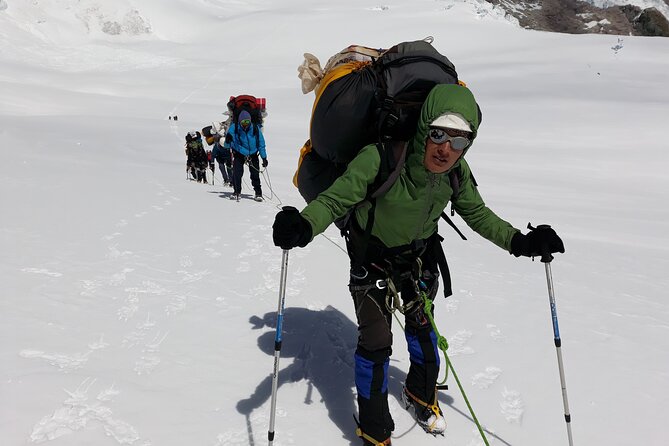
Day 7 crosses Punta Union Pass. From the pass, you can look across the Santa Cruz valley and see the route ahead. This is one of the great visual moments of the trek, but it also marks a clear change in altitude and effort.
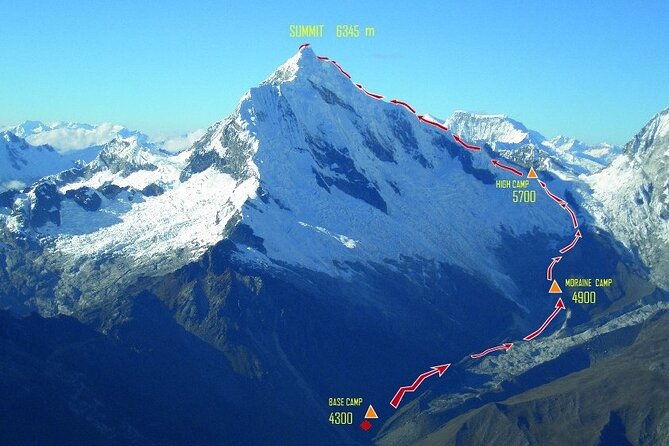
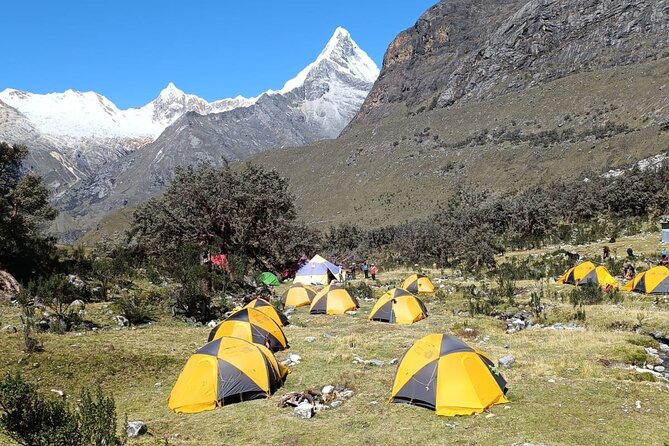
After the pass, you descend to Taullipampa at roughly 4,250 meters and continue toward Alpamayo Base Camp. The camp at Quebrada Arhuecocha sits at about 4,300 meters. At this point, Alpamayo is no longer just a distant name on a map. You can see the mountain that will occupy the next several days.
Day 8 shifts from trekking to expedition movement. After breakfast, the local porters, cook, and guides join the climbing phase. You cross steep moraine terrain toward Moraine Camp at 4,900 meters, with around four hours of walking.
Moraine travel can be tiring because the ground is uneven and unstable. The short distance does not mean an easy day. At nearly 5,000 meters, every step costs more effort, and camp comfort becomes basic.
Longer treks from Huaraz:
- The Best of Huayhuash Mini Trek – Siula Grande Mountain (5D /4 N)
★ 5.0 · 6 reviews - Cordillera Huayhuash Classic Trek – 8 Days & 7 Nights
★ 5.0 · 5 reviews - Salkantay Classic Trek 5 Days from Cusco
★ 5.0 · 4,062 reviews - 4-Day Salkantay Trek with Sky Camp Stay
★ 5.0 · 3,346 reviews
Alpamayo High Camp and the French Route
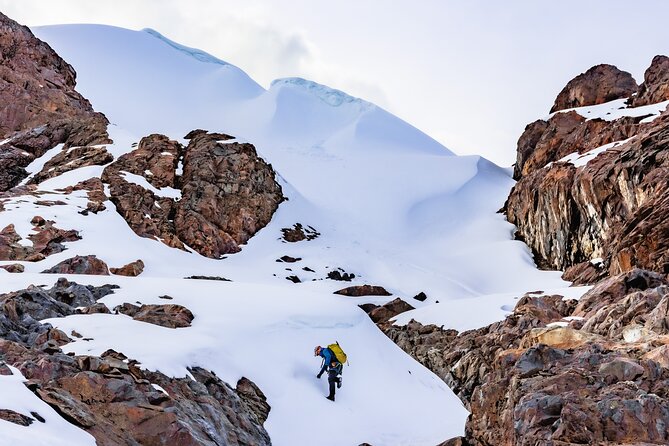
Day 9 takes you higher, to Alpamayo High Camp at about 5,300 meters. The camp is placed on the steep glacier below Alpamayo and Quitaraju. Because the glacier is shrinking, the route and camp position can change from year to year. That is an important practical point: mountain plans are not fixed like museum opening hours.
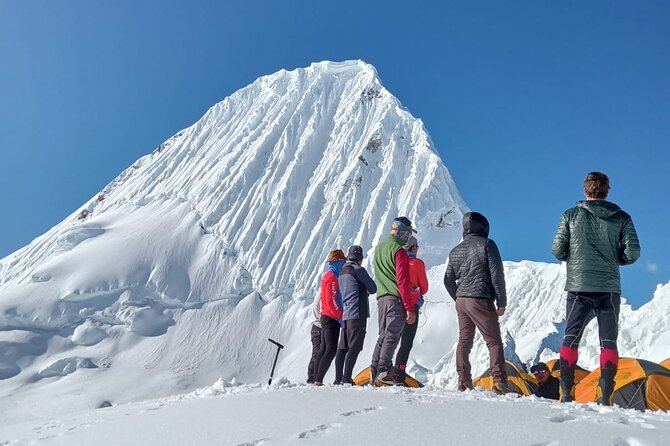
The summit looks close from High Camp, but the altitude and terrain make the next day serious. Dinner is scheduled early, followed by a very early start for the climb.
The proposed Alpamayo route is the French Route, with ice climbing on a wall between 60 and 80 degrees. The wall narrows near the top, followed by several meters to the highest point of a narrow ridge. This is technical mountaineering, not a simple walk with crampons.
Summit day is listed at up to 18 hours. The climb to the top takes roughly five to six hours, and the descent two to three hours in good conditions, though the full day can include movement back toward Base Camp. You descend by rappel along the route climbed.
From the summit, you can look toward Quitaraju at 6,036 meters and Huascarán at 6,768 meters. The view is a major reward, but the return is where fatigue becomes a real concern. If the group is tired, an extra night at High Camp is possible. If everyone is in good shape, the descent continues to Alpamayo Base Camp at 4,300 meters.
Day 11 is held as a spare day for poor weather or for a delayed return from High Camp. I consider this one of the better features of the plan. A mountain itinerary without weather space is often wishful thinking.
A necessary reset in Huaraz
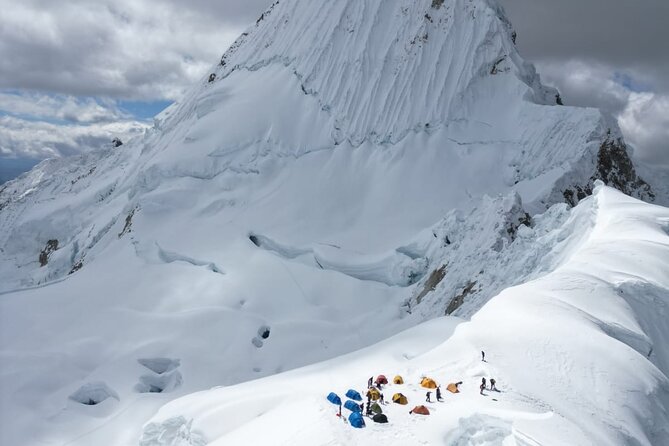
Day 12 descends through the Santa Cruz valley to Cashapampa in about six hours. A minibus then takes you and the local expedition team back to Huaraz.
Day 13 is a rest day, though rock climbing at the walls of Chancas is offered as an option. Chancas is about 40 minutes north of Huaraz and has eight developed routes of varying difficulty. You can also visit local hot springs after climbing.
I would treat the rock climbing as optional in the fullest sense of the word. After Alpamayo, your best use of the day may be food, sleep, laundry, and careful preparation for Chopicalqui. The second peak is not a gentle encore.
Chopicalqui Base Camp and glacier camps
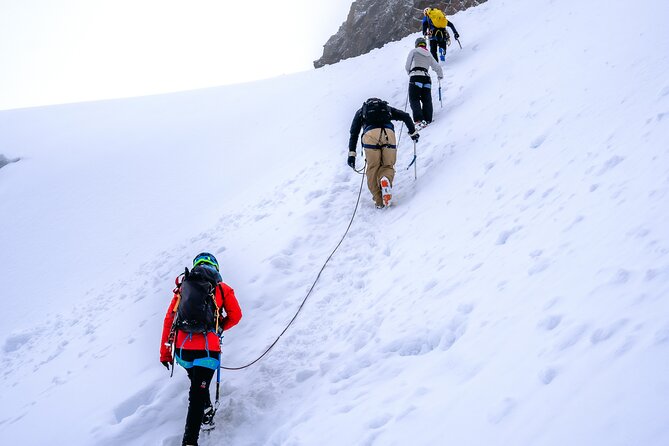
On Day 14, you travel through Quebrada Llanganuco. Private transport takes about three to three and a half hours, followed by roughly five hours of climbing to Chopicalqui Moraine Camp at 4,900 meters. The day is listed at about ten hours.
This is efficient, but not relaxed. You move from Huaraz at 3,100 meters to Base Camp at 4,350 meters and then higher to the moraine. Good organization matters here, and the private transport helps avoid the delays that can occur with public connections.
Day 15 begins on rocky moraine and continues onto the glacier. You cross several glacier slopes and crevasses before reaching High Camp. The day takes about five to six hours.
Chopicalqui’s character differs from Alpamayo’s. You should expect glacier travel, crevasse crossings, seracs, and technical walls. The terrain calls for disciplined movement and close attention to your guide’s instructions.
Chopicalqui summit day at 6,354 meters
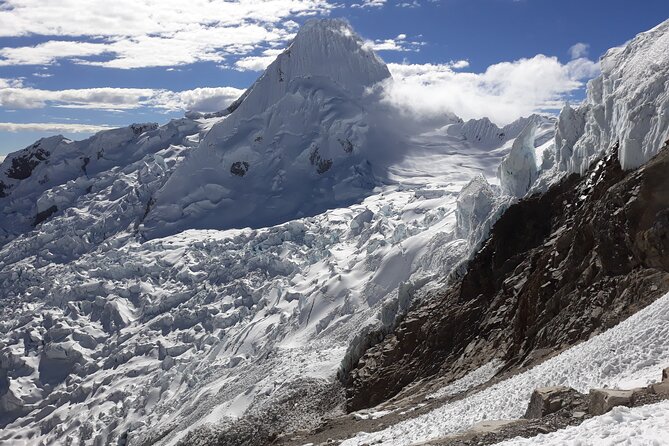
Day 16 is the expedition’s hardest scheduled day. The summit climb is listed at ten to 13 hours, with a final upper section containing eight to ten meters of 75 to 80-degree slope.
You also face seracs and crevasses before reaching the steeper climbing. After the summit, you descend to High Camp or Moraine Camp and continue to Base Camp. This is a long day at extreme altitude, so the one-to-two guide ratio has real value.
The program does not promise a summit at any cost. Weather, snow conditions, route changes, and physical condition can all alter the plan. That is not a weakness in the experience. It is the basic reality of climbing a 6,354-meter peak.
Day 17 returns you to the highway and then to Huaraz. You leave the Llanganuco valley and spend the night at the hotel. Day 18 takes you back to Lima by bus or flight, followed by an overnight international flight on Day 19 and arrival home on Day 20.
What the $3,960 price really covers
At $3,960, the price is best judged as an expedition package rather than a normal tour. It includes Lima and Huaraz hotels, Lima to Huaraz transport, airport transfers, private vehicles during the program, Huascarán National Park entrance fees, guides, cooks, porters, donkeys, food during the trek, tents, kitchen equipment, and base camp facilities.
Meals include 17 breakfasts, 14 lunches, and nine dinners, along with snacks and afternoon tea during the mountain section. City meals in Lima and Huaraz are on you, which gives you freedom to choose restaurants but adds to the budget.
The package includes a dining tent, kitchen tent, toilet tent, tables, chairs, personal tents, and cooking equipment. Single tents can be requested at Base Camp only. This is a solid level of support for a two-peak expedition.
You must supply or rent your own personal climbing equipment. The excluded list includes boots, ice axe, crampons, harness, sleeping bag, mat, Gore-Tex clothing, and related gear. Travel accident and health insurance, luggage insurance, cancellation cover, tips, airport exit tax, personal expenses, and extra hotel nights are also excluded.
Before paying, ask for the exact equipment checklist and confirm what can be rented locally. Also ask how weather delays affect extra hotel nights and transport.
Who should book this expedition?
You should consider this trip if you already have strong physical fitness and genuine glacier or mountaineering experience. The program includes steep ice up to 80 degrees, rappelling, crevasse crossings, seracs, high camps, and summit days lasting as long as 18 hours.
It suits a climber who wants two major Cordillera Blanca peaks with a guided support team, rather than someone seeking a relaxed trekking holiday. The early acclimatization walks help, but they do not replace technical training or experience with crampons, ropes, and an ice axe.
The maximum group size is 12, while the climbing guide ratio is one guide for every two clients. That combination can provide a more controlled climbing group, especially on narrow glacier terrain.
The company has received strong praise for organization, logistics, certified guides, and personal service. One especially positive account names Eric Albino and credits the team with careful planning and warm, attentive handling. Another highlights the AGMP UIAGM-certified guide standard. I would still ask who your assigned guide will be, what technical qualifications apply to your specific climb, and how the team handles a summit change.
There is also a final note about Huascarán being closed or unclimbable, with Chopicalqui or Tocllaraju listed as alternatives. Since this program already includes Chopicalqui and Alpamayo, ask the operator to explain exactly how that contingency applies to your booking.
Should you book Alpamayo and Chopicalqui?
Book it if you want a serious, carefully supported Andes expedition and you understand that the mountains set the timetable. The acclimatization, Santa Cruz crossing, private transport, camp staff, guide ratio, and spare weather day make the $3,960 price reasonable for a climber who would otherwise have to arrange every piece alone.
Do not book it as your first high-altitude holiday. Alpamayo and Chopicalqui demand technical skill, stamina, patience, and the ability to accept a changed route or missed summit.
For the right climber, this is a powerful combination: the open views from Punta Union, the quiet rhythm of mule-supported camps, the steep ice of Alpamayo, and the demanding glacier work on Chopicalqui. Confirm the equipment plan, insurance requirements, guide assignment, weather policy, and the unusual alternative-peak wording before you commit. Then you can focus on the part that matters most: arriving prepared.
FAQ
How long does the Alpamayo and Chopicalqui experience last?
The program lasts approximately 20 days, including time in Lima, acclimatization in Huaraz, the Santa Cruz Trek, both climbing expeditions, return transport, and international travel days.
Where does the experience begin?
The listed meeting point is Grupo Alpamayo Tours & Hotel, Av. Mariscal Toribio Luzuriaga 475, Huaraz 02002, Peru. The listed start time is 1:00 pm.
What is the price per person?
The listed price is $3,960 per person.
Are hotels included?
Yes. The package includes a three-star hotel in central Lima and three-star accommodation in Huaraz, such as Hotel Valery, Hotel Rubi, or a similar property.
Are meals included?
Meals are included during the trek and expedition section, with 17 breakfasts, 14 lunches, and nine dinners listed. Meals and drinks in Lima and Huaraz are not included.
Is climbing equipment included?
No. Personal equipment such as boots, an ice axe, crampons, harness, sleeping bag, mat, and Gore-Tex clothing is not included.
Can I cancel for a full refund?
Yes, if you cancel at least 24 hours before the experience start time. Cancellations or changes made less than 24 hours before the start time are not refunded, and the experience requires a minimum number of participants.
More Hiking Days from Huaraz
- Laguna 69 Day Trek
★ 4.0 · 9 reviews - Huaraz: Laguna 69 | Cordillera Blanca | Hike to Lake 69
★ 4.5 · 9 reviews - Ancash: Trekking to Paron Lagoon with Entrance | Full day|
★ 4.1 · 9 reviews - From Huaraz: Lake 69 Trek Day Tour – White Mountain Range
★ 4.7 · 7 reviews
Added recently around Huaraz
- Snowy Mateo – Cordillera Blanca Expedition★ 5.0 · 26 reviews
- The Best of Huayhuash Mini Trek – Siula Grande Mountain (5D /4 N)★ 5.0 · 6 reviews
- Cordillera Huayhuash Classic Trek – 8 Days & 7 Nights★ 5.0 · 5 reviews
- Pastoruri Glacier Day Trip★ 4.0 · 4 reviews
- Parón Lake – Cordillera Blanca – Private Service★ 5.0 · 8 reviews
- Full day hike in Lagoon 69 with Transportation★ 4.0 · 4 reviews
- Climbing Mateo – Your first 5 thousand★ 5.0 · 52 reviews
- Tour Climbing Nevado Mateo | Your First 5,150 m Summit | 12 Hours★ 5.0 · 40 reviews
Andean Trekking Tours, compared.
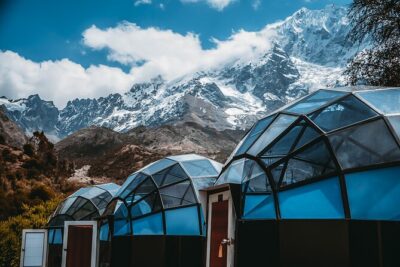
Salkantay Trek 5D/4N with Glass Cabins, Domes and Hobbit House
Read our review →
Lares Valley Trek with Hot Spring 4-Day, 3-Night
Read our review →
Ultimate Salkantay Trek to Machu Picchu 5 Days
Read our review →
Lares Trek to Machu Picchu 4D/3N Including Hot Springs
Read our review →
4-Day Inca Jungle Trail to Machu Picchu Hiking and Biking Tour
Read our review →Browse the lists this tour appears in