
Reviewed · INCA RUINS & ARCHAEOLOGICAL SITES
Cusco: City Tour | Half-Day Tour to 4 Archaeological Sites
Cusco reveals its secrets in stone. This half-day outing links the city’s major Inca and colonial sights, giving you a quick but useful introduction to Qoricancha, Sacsayhuamán, Qenqo, Puca Pucara, and Tambomachay. I like the strong mix of city history and nearby ruins, and I like the hotel pickup, which saves you the usual morning search for a meeting point. The $29 price is attractive, though entrance tickets cost extra and bilingual guiding can make the day feel slower.
The guides are the heart of the experience. Luis, Maribel, Joel, Yenny, Jessica, and others have been praised for clear explanations, patience, humor, and care with English-speaking visitors. I also like that the route combines short walks with transport, rather than asking you to spend four straight hours on foot. The main caution is timing: some departures have run longer than four hours, and one group spent too much time at an unplanned textile market.
In This Review
- Key points to know before booking
- Why this four-hour route works so well
- Qoricancha, where Inca and Spanish power share one site
- Sacsayhuamán and the famous zigzag walls
- Qenqo, a ceremonial site cut into stone
- Puca Pucara, the watch post on the road
- Tambomachay and the sound of running water
- The guides make the difference
- Transport, pickup, and the real pace
- What the $29 price really covers
- Who should book this Cusco tour?
- Should you book it?
- FAQ
- How long does the Cusco City Tour last?
- Which archaeological sites are included?
- Is hotel pickup included?
- Is transportation included?
- Is a guide included?
- Are entrance tickets included?
- Is the Cathedral of Cusco included?
- Can I cancel for a full refund?
- Can I reserve now and pay later?
Key points to know before booking
- Five major sites in one half-day: You visit Qoricancha, Sacsayhuamán, Qenqo, Puca Pucara, and Tambomachay.
- Excellent guide-led introduction: Luis and several other guides are praised for explaining Inca history, local culture, and site details in clear English and Spanish.
- Tickets are not included: Qoricancha costs 20 soles, while the Cusco Tourist Ticket costs between S/70 and S/120 depending on the ticket type.
- Hotel pickup is included: Pickup applies to hotels in Cusco’s historic center.
- The afternoon departure has a bonus: A 2 p.m. start can finish with an evening view over Cusco and leave you free for dinner.
- Bilingual pacing varies: The guide alternates between English and Spanish, which some people appreciate and others find time-consuming.
Why this four-hour route works so well
Cusco is full of Inca walls, colonial churches, museums, and archaeological sites. The problem is not finding something to see. The problem is knowing how to connect the important pieces without wasting half a day on taxis or poor directions.
This tour gives you a sensible first look. You begin near the center, then travel uphill and outward to the large ruins above Cusco. That order helps you understand the city as part of a wider Inca capital, not just as a pretty Spanish colonial town.
I would use this tour early in a Cusco stay. It gives you names, dates, buildings, and cultural context that make later visits more rewarding. A guide can point out how Inca stonework differs from Spanish construction, explain the role of water and ceremony, and show why Sacsayhuamán is more than a scenic pile of giant rocks.
The tour is sold as four hours, but allow some flexibility. A few groups have finished late, especially when transport pickup was slow or when an additional market stop was included. If you have a fixed dinner reservation, train connection, or evening show, leave a buffer.
More City Tours in Cusco
- Cusco: Half-Day City Tour with Sacsayhuaman and Q’enco
★ 4.6 · 1,129 reviews - City Tour Cusco Qoricancha Sacsayhuaman y Tambomachay
★ 4.7 · 617 reviews - Cusco City Tour Four Ruins in Half-Day
★ 5.0 · 530 reviews
Qoricancha, where Inca and Spanish power share one site
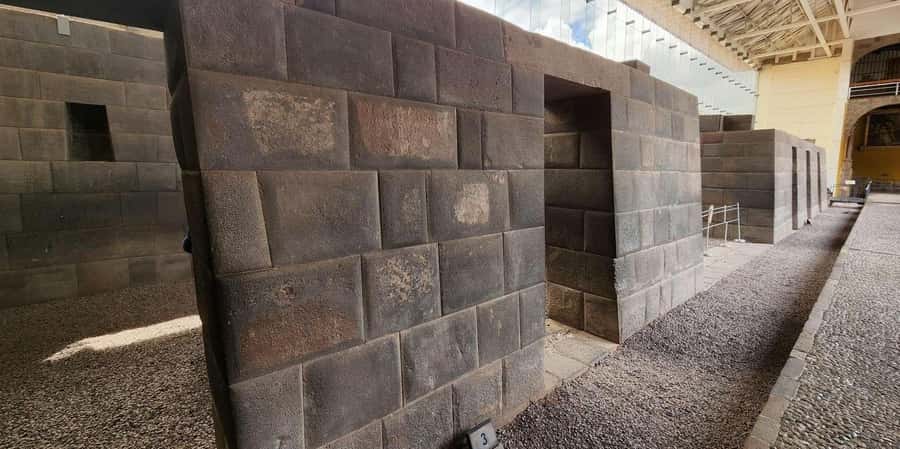
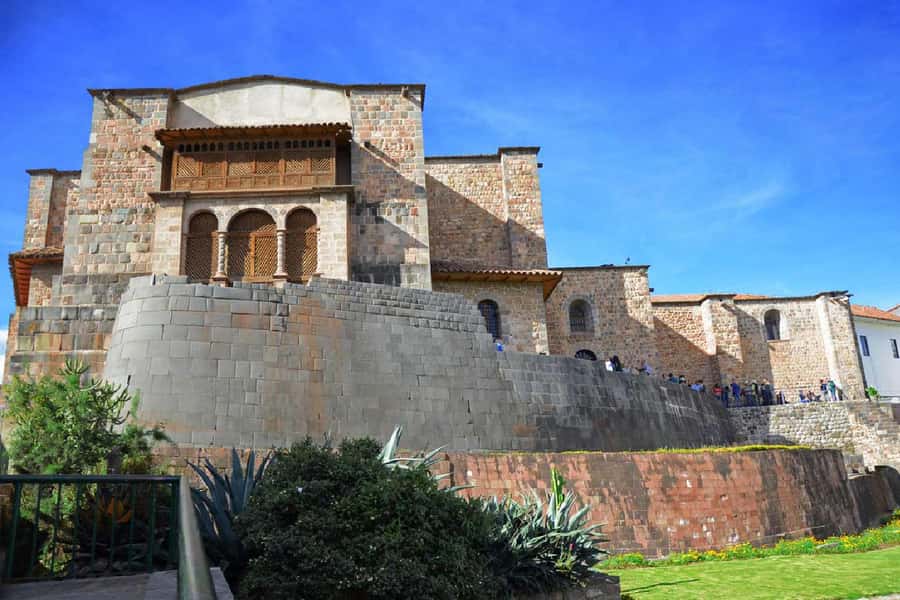
Qoricancha is the city stop, and it gives the tour its best lesson in cultural layers. The Inca temple was dedicated to the sun and served as one of the most important religious centers in the empire. After the Spanish conquest, the Temple of Santo Domingo was built on the same site.
Inside, you can see the unusual meeting of two building traditions. The Inca masonry is precise, with carefully fitted stones and strong geometric lines. The colonial section includes paintings from the Cusquenian School, adding another chapter to the story of Cusco.
Your guide explains the different temple areas and the engineering used to build them. This is especially useful because Qoricancha can look simple at first glance. The real interest is in how the walls, religious purpose, and later Spanish building fit together.
The 20-sol entrance fee is not included. Bring cash, as the payment arrangement for site tickets is important to confirm before you set out. You may also need the Cusco Tourist Ticket, priced between S/70 and S/120 depending on the option available. Some people buy the ticket in advance near the Plaza de Armas, which can save time during the tour.
The tour description begins with Cusco’s main square, but the listed site visit focuses on Qoricancha. Do not assume you will receive a long, separate Plaza de Armas visit. If that square is a priority, plan time to explore it on your own.
Sacsayhuamán and the famous zigzag walls
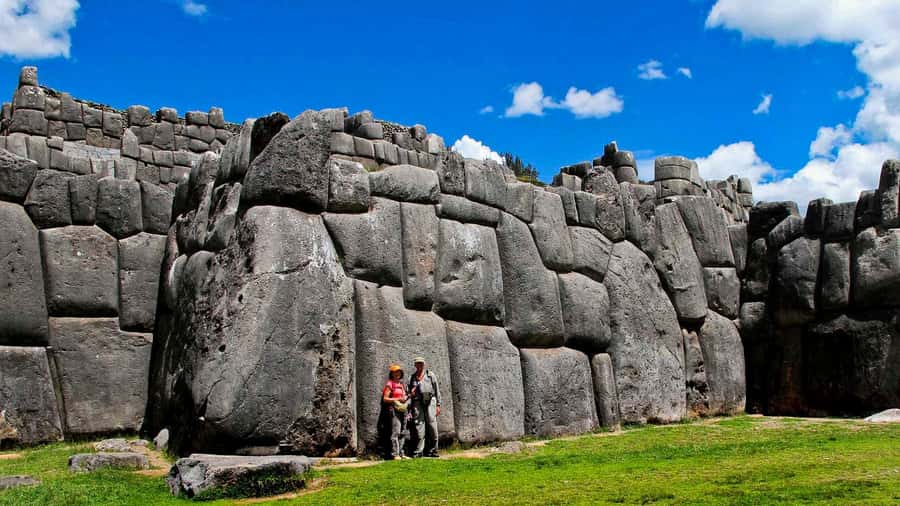
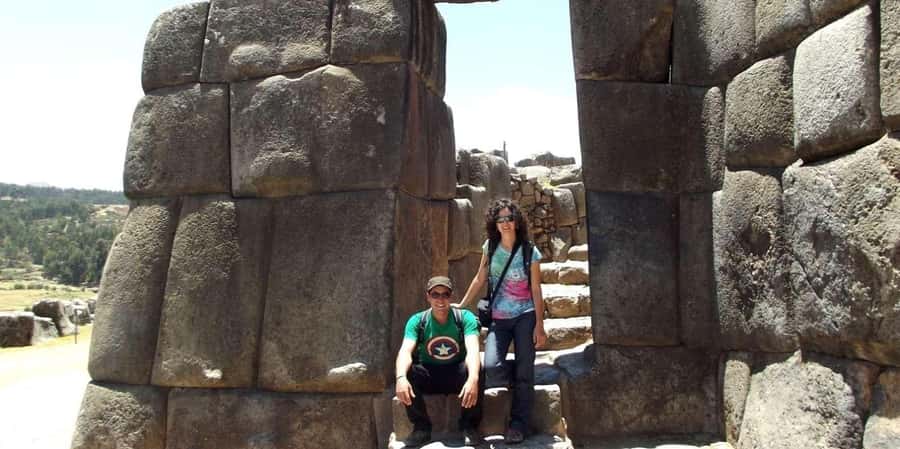
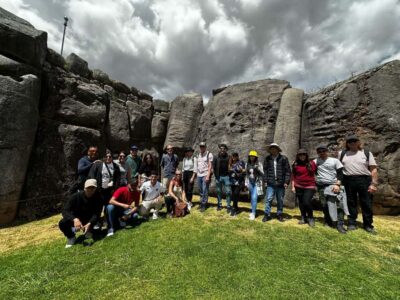
Sacsayhuamán is the visual high point of the route. The site is known for enormous stones fitted together with remarkable precision. Some blocks are described as reaching about 9 meters high and weighing more than 350 tons.
You do not need to be an engineer to appreciate the scale. The stones create a powerful sense of strength, while the terraces and open spaces show that this was not simply a defensive wall. The site had ceremonial and political importance as well.
Sacsayhuamán is also linked with Inti Raymi, the Festival of the Sun, held each June 24. Your guide can give that celebration a wider setting and explain why the site remains important in Cusco’s cultural life.
This is the stop where poor timing hurts most. One group reached Sacsayhuamán only about 30 minutes before closing after an unwanted textile market visit. That is not a guaranteed part of every departure, but it shows why you should ask the guide about the planned order and ticket arrangements at the start.
Once the group is moving properly, the schedule is generally praised as well organized. You get a good mix of explanation, photographs, and time to look around. Still, the site is large enough that four hours for the whole route means you cannot inspect every wall or terrace at length.
Qenqo, a ceremonial site cut into stone
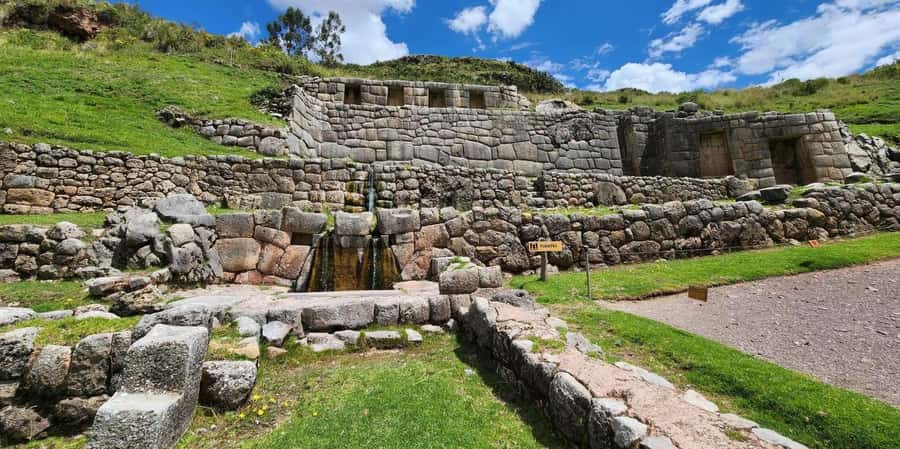
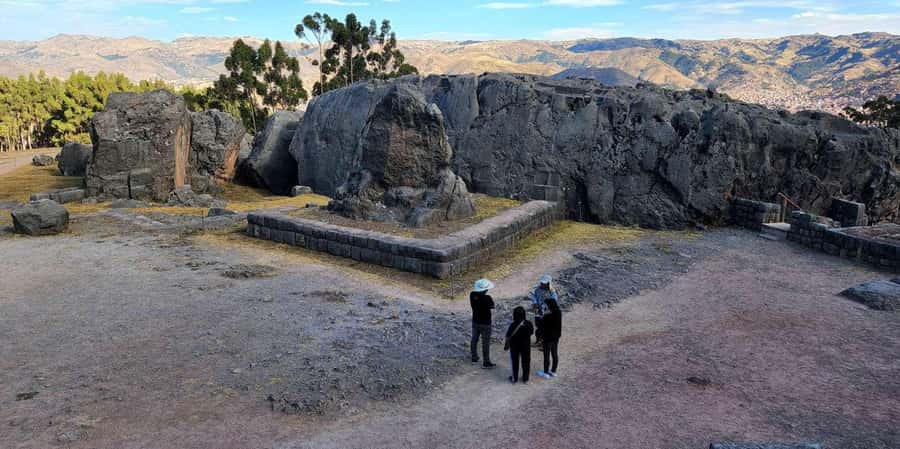
Qenqo feels more mysterious than grand. Instead of huge open terraces, you find rocky outcrops, carved surfaces, narrow passages, and an amphitheater-like area connected with ceremony.
The site is described as a religious and ceremonial center, with sacrifices taking place there in Inca times. A guide adds value here because the stone formations do not always explain themselves. Without context, you may see a collection of unusual rocks. With an explanation, you begin to understand how the carved spaces and enclosed paths may have been used.
This is also one of the stops where you should expect uneven walking and short periods in tight spaces. The tour does not list a specific accessibility program, so anyone who needs extra time should tell the guide early.
Qenqo is a good contrast with Sacsayhuamán. One site impresses through mass and scale. The other asks you to look closely at rock, shape, and ritual purpose.
More Ruins & Archaeology Tours in Cusco
- Cusco City Sightseeing and Sacsayhuaman Archeological Park Tour
★ 4.5 · 101 reviews - Cusco: Historical Guided City Tour with 4 Inca Ruins
★ 4.5 · 99 reviews - Cusco 4-Hour Private Tour Including Sacsayhuaman and Qenqo
★ 5.0 · 77 reviews - Cusco: Half-Day City Tour with Sacsayhuaman and Qenqo
★ 4.5 · 77 reviews
Puca Pucara, the watch post on the road
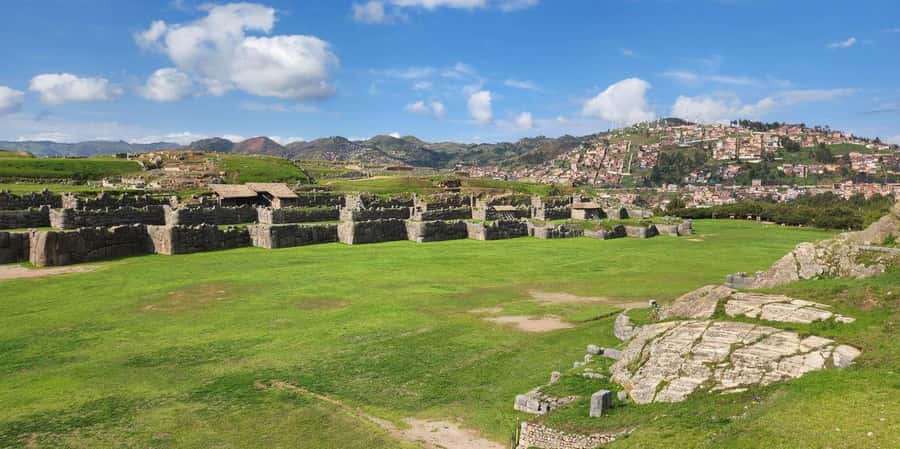
Puca Pucara is smaller and more direct. Its name is often translated as Red Fortress, and the site served as an Inca surveillance post and entry-control point for the capital.
You will see terraces, walls, and stone steps spread across a position connected with movement in and out of Cusco. The stop helps explain the wider network around the imperial city. The Incas did not build their capital in isolation. Roads, checkpoints, ceremonial centers, and water sites all worked together.
I find Puca Pucara most useful when the guide connects it to the route rather than treating it as another pile of stones. It is not the biggest stop, but it gives the tour a practical side. Cusco was a capital that needed to control roads and watch approaching traffic.
Because the visit is brief, you have time for photographs without losing the whole afternoon. The tradeoff is that you will not get the same long exploration period available on a private tour.
Tambomachay and the sound of running water
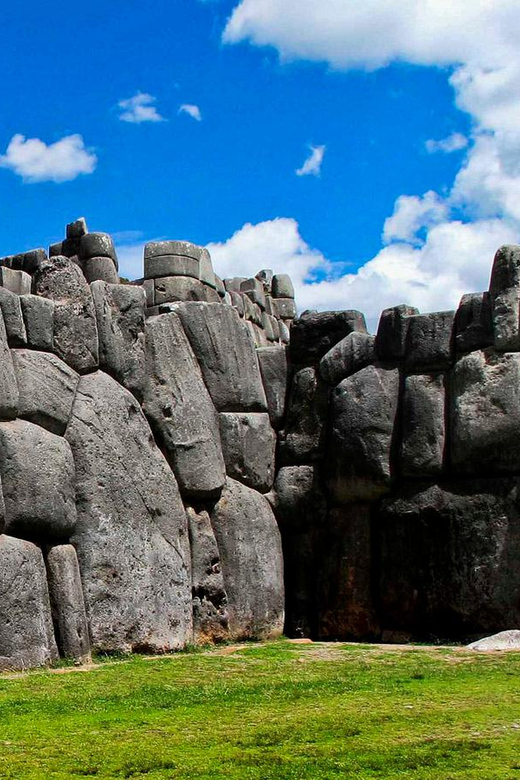
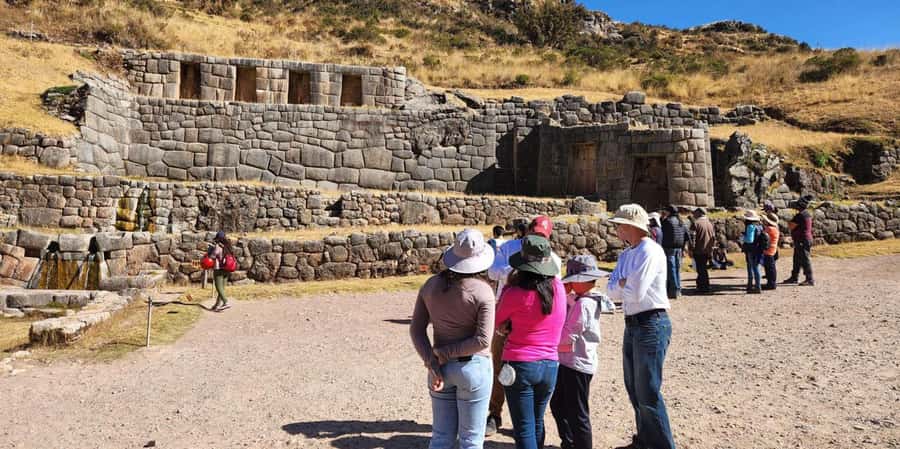
Tambomachay is the final archaeological stop and one of the most pleasant. It is associated with water worship, fountains, and leisure. It is also known as a place connected with eternal youth.
The site’s channels and fountains make water the focus. That gives the route a calm ending after the massive walls of Sacsayhuamán and the darker ceremonial feel of Qenqo. Your guide can explain why water mattered so much in Inca religion and daily life.
Do not rush this stop. One person specifically advised saving time for the final location because the view over Cusco is excellent. If your tour leaves in the afternoon, the return can coincide with evening light over the city, followed by dinner in the center.
Weather can change quickly. An October departure was described as cold toward the end, and an afternoon group encountered rain. Bring layers and a light rain jacket. Vendors may sell hot tea along the route, but do not rely on that as your only plan.
The guides make the difference
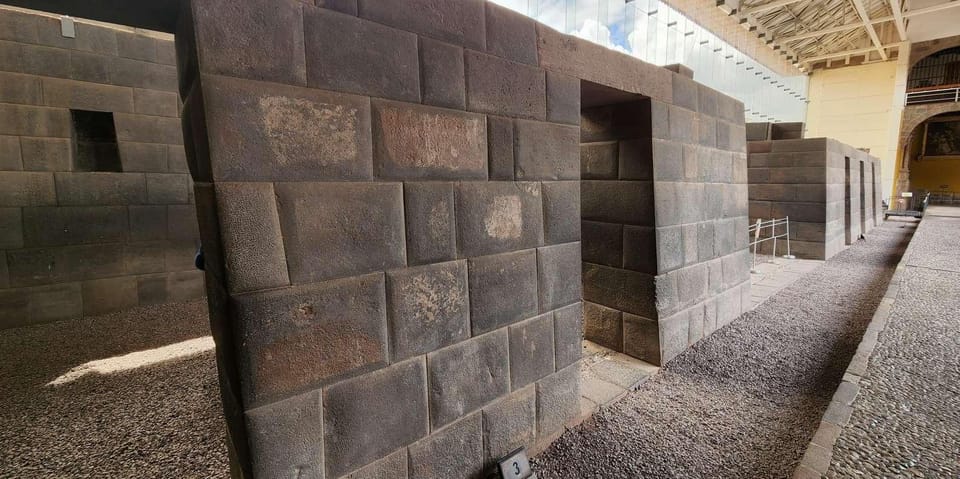
The strongest part of this experience is the guiding. Luis is repeatedly praised for his warmth, humor, local knowledge, and ability to include English speakers in a Spanish-heavy group. Maribel, Joel, Yenny, Jessica, Fabrisio, America, and Leo have also been praised for clear explanations and friendly service.
You can expect the guide to alternate between English and Spanish. Some guides handle this very well, repeating the same material patiently and making sure no one is left behind. English-speaking participants have specifically appreciated being included even when they were the only native English speaker in the group.
Still, bilingual tours have a built-in weakness. Every explanation takes longer, and questions in one language may not always be repeated in the other. One person felt that English questions were not always passed along after Spanish discussions. If you want a fast, tightly focused English tour, a private option may suit you better.
There is also a small caution about presentation. One guide was praised for a great deal of information but was also encouraged to separate established facts from theories. At Inca sites, some interpretations remain uncertain. A careful guide should tell you when an idea is accepted evidence and when it is only a possible explanation.
Transport, pickup, and the real pace
Hotel pickup is included for properties in Cusco’s historic center. That is a practical benefit, especially if you are still adjusting to the altitude and do not want to locate a meeting point.
The tour uses tourist transport between sites, with walking at the archaeological complexes. This creates a good balance for a half-day outing. You get out, listen, walk, take photos, and return to the vehicle rather than spending the whole time climbing between locations.
The weak point can be the start. Some departures have had late or chaotic pickups, and one person felt the transport process needed improvement. Once the group was underway, the schedule generally ran well, but you should not plan a major activity immediately afterward.
A four-hour tour can also stretch to five or even five and a half hours. That longer duration is not necessarily bad if you are enjoying the sites, but it matters if your evening is tightly planned. Ask about the expected return time before leaving the center.
What the $29 price really covers
At $29 per person, this is a strong value if you want a guided introduction rather than independent sightseeing. The fee covers hotel pickup, transport, and a bilingual guide. It does not cover the archaeological entrance fees.
The extra ticket costs change the final price. Qoricancha requires 20 soles, and the Tourist Ticket costs S/70 to S/120. The Tourist Ticket may also cover other museums and sites, depending on the ticket type, so it can be useful beyond this one afternoon.
I would calculate the total before booking. The tour is cheap for the amount of ground covered, but it is not a $29 all-inclusive visit. Carry the required cash, and if you already purchased the relevant ticket for another Cusco or Sacred Valley outing, show it to the operator.
The optional Cathedral of Cusco visit is another cost and is not part of the core route. Treat it as an add-on, not something included in the advertised four-hour experience.
Who should book this Cusco tour?
I would recommend it to first-time visitors who want a fast orientation, couples and families who prefer transport between sites, and anyone with only a short stay in Cusco. It also works well after arrival, once you have had enough time to settle in and want a clear introduction to the city’s archaeological setting.
It suits you especially well if you enjoy listening to a guide and asking questions. The history of the sites is easier to follow when someone explains how temples, roads, water systems, ceremonies, and defenses fit together.
You may want another option if you need a strict finish time, dislike bilingual tours, or want long, quiet visits at each ruin. The route covers a lot, but that means each stop receives limited time. You might also prefer a private guide if you want to set the pace or focus on photography.
The tour has earned a 4.6 rating from 206 bookings, with especially strong praise for the guides, organization, value, and range of sites. The occasional problems involve ticket confusion, transport delays, bilingual pacing, and unwanted shopping stops, not the main archaeological route itself.
Should you book it?
Book this tour if you want five important Cusco sites in one affordable half-day, and you are comfortable paying entrance fees separately. The best guides, especially Luis and Maribel, turn a busy route into a useful lesson in Inca engineering, religion, government, and local culture.
Before you go, confirm the pickup time, bring cash for Qoricancha and the Tourist Ticket, wear layers, and leave room in your evening schedule. If possible, choose an afternoon departure for the city view at the end. For a first look at Cusco’s major ruins, this is a practical choice with plenty of substance for the price.
FAQ
How long does the Cusco City Tour last?
The advertised duration is four hours. Some departures may run longer because of pickup delays, traffic, bilingual explanations, or extra stops.
Which archaeological sites are included?
The route includes Qoricancha, Sacsayhuamán, Qenqo, Puca Pucara, and Tambomachay.
Is hotel pickup included?
Yes. Pickup is included from hotels located in Cusco’s historic center.
Is transportation included?
Yes. Tourist transport between the sites is included in the tour price.
Is a guide included?
Yes. A live bilingual guide is included, with English and Spanish available.
Are entrance tickets included?
No. Qoricancha requires a separate 20-sol entrance fee. You also need the Cusco Tourist Ticket, priced between S/70 and S/120 depending on the ticket type.
Is the Cathedral of Cusco included?
No. The Cathedral is an optional visit and is not included in the main tour.
Can I cancel for a full refund?
Yes. You can cancel up to 24 hours in advance for a full refund.
Can I reserve now and pay later?
Yes. The booking option allows you to reserve your place and pay later.
More Ruins and Archaeology near Cusco
- Sacsayhuaman Temple, Tambomachay and Puca Pucara Half-Day Tour
★ 4.5 · 59 reviews - Private Cusco City Tour with Sacsayhuaman & Inca Sites
★ 5.0 · 52 reviews - Private Ollantaytambo, Pisac Ruins Tour with Farm Visit, Gourmet Picnic Lunch
★ 5.0 · 52 reviews - Cusco City Tour with Sacsayhuaman & Inca Sites – Small Group
★ 5.0 · 48 reviews
Added recently around Cusco
- Guided tour of the mountain of colors in Cusco★ 5.0 · 11 reviews
- 2-Day Private Short Inca Trail to Machu Picchu★ 5.0 · 15 reviews
- Tour Sacred Valley with Maras and Moray★ 5.0 · 15 reviews
- San Pedro Market Tour with Peruvian Cooking Class★ 5.0 · 31 reviews
- City Tour Cusco – Group★ 5.0 · 4 reviews
- Walking Culinary Experience★ 5.0 · 41 reviews
- City Tour in Cusco★ 4.5 · 10 reviews
- One Day Tour to Humantay Lagoon★ 5.0 · 8 reviews
Inca Ruins & Archaeological Sites, compared.
Half-Day City Tour with Sacsayhuaman and Q’enco
Read our review →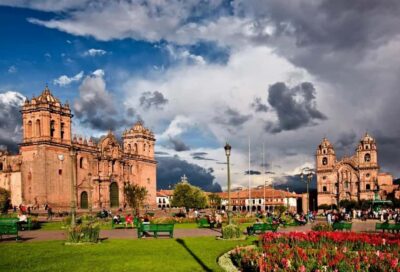
City Tour Cusco Qoricancha Sacsayhuaman y Tambomachay
Read our review →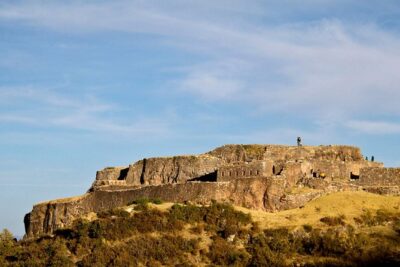
Pachacamac Ruins & Barranco Half-Day Guided Tour
Read our review →
Pre Inca Temple of Pachacamac Half-Day Tour from Lima
Read our review →
Tour to the Archaeological Sanctuary of Pachacamac (small group)
Read our review →
From Pyramids & Bohemian Streets: Lima Miraflores & Barranco Tour
Read our review →
Caral, The Oldest Civilization in the Americas:Day Trip from Lima
Read our review →Browse the lists this tour appears in