
Reviewed · INCA RUINS & ARCHAEOLOGICAL SITES
Half-Day Cusco City Tour: Four Ruins, Cathedral and Qorikancha
Start with stones, not souvenirs. This six-hour Cusco tour connects the city’s Spanish cathedral with Qorikancha and four major Inca sites, giving you a useful first look at the city and its highland setting. I especially like the small maximum group of 12 and the included transport, which make a busy afternoon easier to manage.
I also like the mix of famous places and quieter archaeological stops. Guides such as Elizabeth and Paul have added warmth and clear local context, according to the feedback available. The main drawback is that the entrance fees are extra, and one account says the group did not reach every archaeological stop, so the pace and route may depend on the day.
In This Review
- Key points at a glance
- Why this afternoon tour works well in Cusco
- Cusco Cathedral: a church built over an Inca palace
- Qorikancha: gold, stone, and Santo Domingo
- Sacsayhuaman: giant stones above Cusco
- Q’enqo: a carved rock with unanswered questions
- Puka Pukara: the so-called Red Fortress
- Tambomachay: water at 3,700 metres
- What the $19.25 price really covers
- Timing, group size, and the one route concern
- Who should book this Cusco city tour?
- Should you book it?
- FAQ
- How long does the Cusco city tour last?
- What time does the tour begin?
- Which attractions are included in the route?
- Is hotel pickup available?
- Can the tour pick me up from an Airbnb?
- Can the tour pick me up from a hotel outside the historic centre?
- Is transportation included?
- Is a guide included?
- Are entrance fees included?
- How many people can join the tour?
- Is the tour refundable if I cancel?
Key points at a glance
- Six important sites in about six hours: You visit Cusco Cathedral, Qorikancha, Sacsayhuaman, Q’enqo, Puka Pukara, and Tambomachay.
- A small group capped at 12 people: This gives the guide a better chance to answer questions than a large bus tour.
- The afternoon begins at 1:00 pm: Hotel pickup is available within Cusco’s historic centre.
- The Inca and Spanish story is placed side by side: Cathedral and Santo Domingo help you understand how colonial buildings used earlier Inca foundations.
- The archaeological sites climb above Cusco: Sacsayhuaman, Q’enqo, Puka Pukara, and Tambomachay bring mountain views, stonework, water channels, and ceremonial questions.
- Budget carefully for tickets: Transport and a bilingual English and Spanish guide are included, but Qorikancha costs 15 soles and the archaeological ticket costs either 70 soles for two days or 130 soles for ten days.
Why this afternoon tour works well in Cusco
Cusco can feel like several cities placed on top of one another. Inca foundations support Spanish churches, modern streets run through old ceremonial spaces, and the main square sits below huge stone ruins on the hills. This tour gives you that basic picture in one afternoon.
The route is also practical for a first day in town. You begin in the historic centre, then move outward to the high archaeological sites. That lets you see the city at street level before heading to places where the stonework and views take over.
I would not treat this as a slow, scholarly visit to each ruin. Six stops in roughly six hours means the schedule has to keep moving. Still, the combination is strong: two central monuments, then four Inca sites with different purposes and designs.
The tour is offered in English with a bilingual guide. Elizabeth received especially warm praise for her work, while Paul was noted for his passion for Cusco and for giving people time to look around after his explanations. That balance matters. At ruins, a good guide should explain what you are seeing without talking through every moment.
More City Tours in Cusco
- Cusco: Half-Day City Tour with Sacsayhuaman and Q’enco
★ 4.6 · 1,129 reviews - City Tour Cusco Qoricancha Sacsayhuaman y Tambomachay
★ 4.7 · 617 reviews - Cusco City Tour Four Ruins in Half-Day
★ 5.0 · 530 reviews
Cusco Cathedral: a church built over an Inca palace
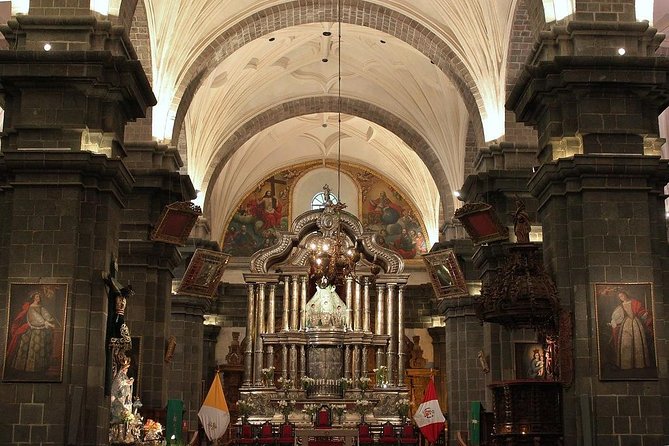
The first stop is Cusco Cathedral on the Plaza de Armas. The Spanish began building it in 1559 over the foundations of Kiswarkancha, the palace associated with Viracocha, an Inca ruler who lived roughly a century before the Spanish arrival.
That location was not an accident. The cathedral was placed at the centre of Cusco partly to replace an important Inca religious and political site with Spanish Catholic worship. You can read the building as both a church and a statement of conquest.
Construction took 95 years and finished in 1654. Its Latin-cross plan, three aisles, 14 supporting pillars, and Gothic-Renaissance style reflect Spanish design from the period of conquest. The facade also carries Baroque touches.
The stone tells a harder story. Much of it came from Sacsayhuaman, the Inca complex above Cusco. Even sacred sand from the main square was reportedly used in the cathedral’s mortar after the Spanish learned that it held religious importance for the Incas.
Allow about 45 minutes here. The admission ticket is not included, so confirm the current entry arrangement before you go. Inside, look for the carved jaguar head on the doors. That small detail is easy to miss, but it shows how Inca symbols survived within a Spanish Christian building.
The Cathedral is a strong opening because it gives the rest of the afternoon a clear frame. You are not just seeing old walls. You are seeing how one religion and political system was pushed aside, while parts of its art, stone, and symbols remained.
Qorikancha: gold, stone, and Santo Domingo
Qorikancha, originally called Intikancha or Intiwasi, was dedicated to Inti, the sun. It was one of the most important religious places in the Inca capital, and Spanish accounts described its former riches in extravagant terms.
The temple walls were once covered with gold sheets. The surrounding court reportedly held golden figures, and the site contained ceremonial objects used by the Inca and the women who served in its religious rites. Much of that gold was later taken when the Spanish demanded a ransom for Atahualpa.
The Spanish built Santo Domingo church and convent on the site, using the surviving Inca foundations. This makes Qorikancha one of the clearest places in Cusco to compare two building traditions at close range.
The Inca stonework is the star. The builders used carefully fitted ashlar masonry, with stones selected and shaped so precisely that the walls could withstand major earthquakes. The colonial church suffered severe earthquake damage, while the Inca walls continued to hold together.
You have about 45 minutes here. Entry costs 15 soles and is separate from the tour price. There is also an underground archaeological museum with mummies, textiles, and sacred idols from the site, though the supplied tour details do not specify how much time the group spends in that museum.
Qorikancha is especially useful if you want to understand why Inca construction still commands attention. The walls are not merely old. They show the power of an empire able to organize large amounts of skilled labor across a wide part of the Andes.
Sacsayhuaman: giant stones above Cusco
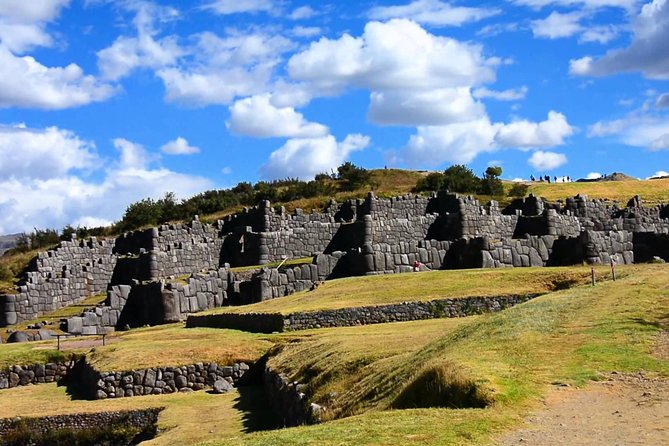
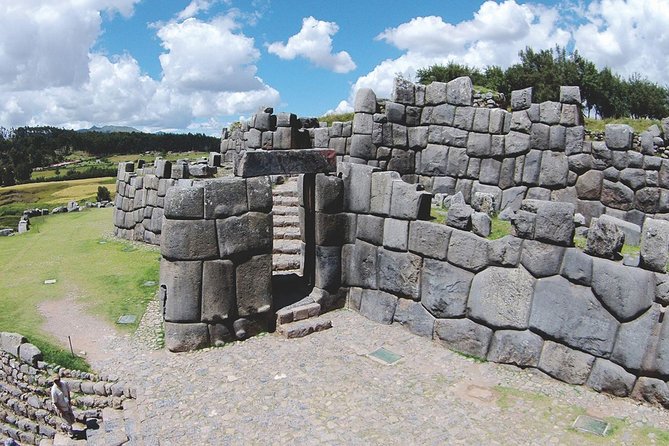
The road then climbs to Sacsayhuaman, the largest and most dramatic stop on the route. Its name is commonly translated from Quechua as place where the hawk is satiated. The complex may have served as a fortress, ceremonial centre, or both.
The Spanish called it a fortress because of its military-looking form. It did serve as a defensive position during the Inca resistance, but the site also contains shrines, towers, residences, storage areas, roads, and aqueducts. That wider mix makes it unwise to think of Sacsayhuaman as only a military structure.
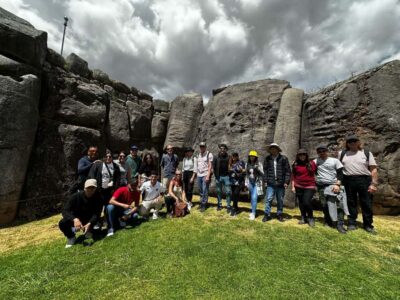
The zigzag walls are the main attraction. Some stones reach about five metres high and two and a half metres wide, with estimated weights between 90 and 125 tons. The scale is impressive even before a guide explains the engineering.
You get roughly an hour here, enough for the principal walls and the views across Cusco. The site also offers sightlines toward Ausangate, Pachatusán, and Cinca, mountains regarded as sacred by the Incas.
This is the place where the tour feels most grand. It is also where good footwear and a little patience help. The site is large, and the route involves archaeological ground rather than a polished museum floor. The tour includes transport, but the details do not promise a particular amount of walking or a private vehicle, so ask the operator if mobility is a concern.
More Ruins & Archaeology Tours in Cusco
- Cusco: City Tour | Half-Day Tour to 4 Archaeological Sites
★ 4.6 · 206 reviews - Cusco City Sightseeing and Sacsayhuaman Archeological Park Tour
★ 4.5 · 101 reviews - Cusco: Historical Guided City Tour with 4 Inca Ruins
★ 4.5 · 99 reviews - Cusco 4-Hour Private Tour Including Sacsayhuaman and Qenqo
★ 5.0 · 77 reviews
Q’enqo: a carved rock with unanswered questions
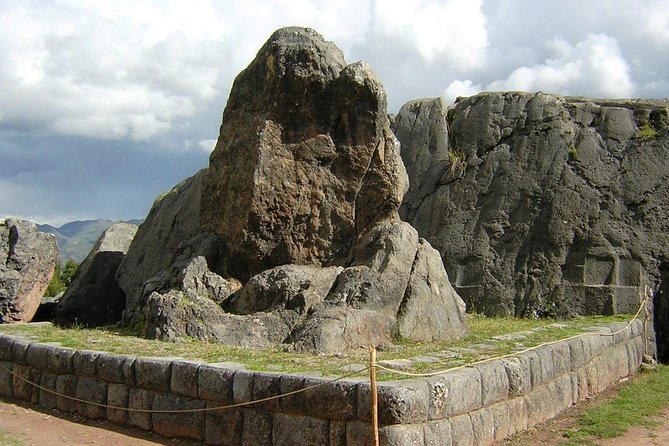
Q’enqo gives the afternoon a different mood. Rather than presenting enormous walls across a broad complex, it centres on a giant monolith carved with channels, chambers, and other features.
In Quechua, Q’enqo refers to a labyrinth or zigzag. A crooked channel cut into the stone has led researchers to suggest several possible uses. It may have carried water, chicha, or blood. These ideas point toward ceremonies connected with death, ritual offerings, or the treatment of bodies, but the exact purpose remains uncertain.
That uncertainty is part of the appeal. You will not get a neat answer to every question here. Instead, the guide can explain the leading interpretations and show how the carving, natural chambers, and man-made passages fit together.
One chamber has 19 small niches and resembles an amphitheatre. Its purpose is also unclear, though it may have been used in ceremonies linked to the sun, moon, and stars.
Plan on about an hour. Q’enqo is close to Cusco, and its compact form makes it a good contrast with Sacsayhuaman. I like this stop because it asks you to look carefully rather than simply admire size.
Puka Pukara: the so-called Red Fortress
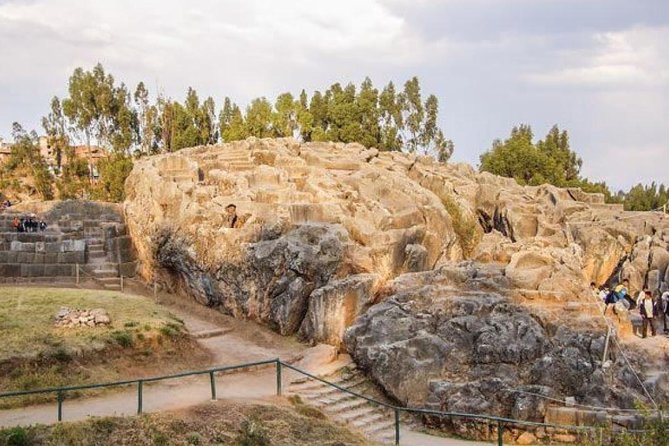
Puka Pukara means red fortress, a name linked to the reddish earth and the site’s position. The name came into use in the twentieth century, which is a useful reminder that modern labels do not always come directly from the Inca period.
The complex contains courtyards, canals, aqueducts, baths, rooms, platforms, and an old road connected with the Qhapaq Ñan, the Inca road network. Its walls use small and medium stones with a rougher finish than the tightly fitted blocks at Qorikancha or Sacsayhuaman.
The layout follows three levels of walls. Rooms were placed around the contours and existing rocks, rather than forcing the site into a simple rectangular plan. Some rooms are rectangular, while others have the trapezoidal shape associated with Inca architecture.
Puka Pukara may have served as a barracks and tambo, or roadside lodging place. According to the historical account, soldiers and dancers accompanying the Inca could wait here while he visited the baths at Tambomachay. A supposed tunnel between the two sites is also part of local lore, but the supplied information does not establish it as fact.
You get about an hour at Puka Pukara. It may not have the visual punch of Sacsayhuaman, but it helps you see how the Inca road system, military organization, water management, and royal movement worked together.
Tambomachay: water at 3,700 metres
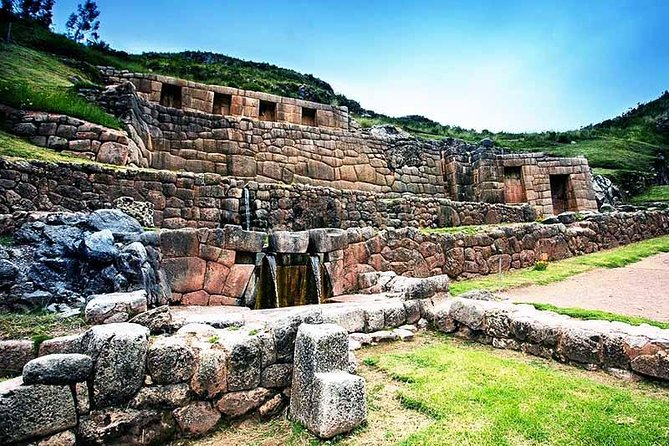
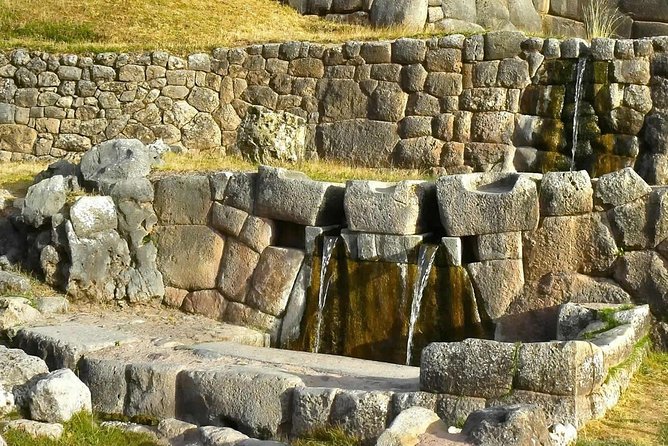
The final stop is Tambomachay, about four miles north of Cusco and roughly 12,150 feet above sea level. Its three stepped terraces are built into a natural spring, with small canals, aqueducts, and waterfalls carrying the water through the stonework.
The site may have been a ceremonial centre, an Inca spa, a military outpost, or a combination of these roles. It is also called El Baño del Inca, or the Bath of the Inca, because one long-standing idea is that the ruler and Inca nobility used it as a retreat.
The water still gives Tambomachay a quiet character. After the larger walls and open views at Sacsayhuaman, the flowing channels make this a more intimate final stop.
You have about 45 minutes here. The altitude is worth noting, especially if Cusco is new to you. The tour can help you get your bearings, but it is not a substitute for taking the first day gently if you are feeling unwell. The supplied details say most people can participate, but they do not provide a specific accessibility assessment.
What the $19.25 price really covers
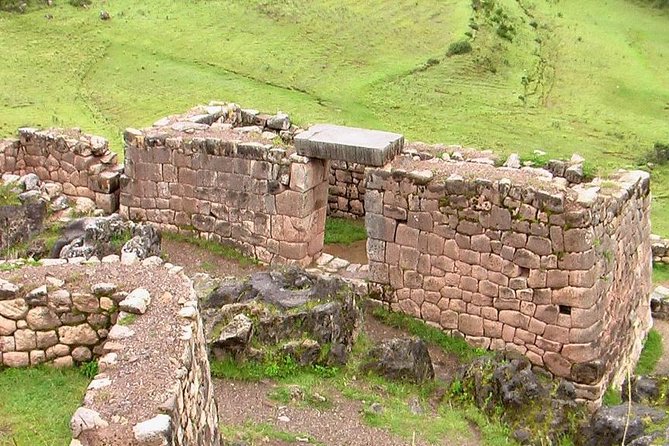
At $19.25 per person, this is an inexpensive way to arrange transport and guiding across six sites. The value is strongest if you would otherwise need to organize several taxis, identify the ruins yourself, and piece together the historical connections on your own.
The headline price does not cover admission. Qorikancha costs 15 soles, while the archaeological sites require a separate ticket priced at 70 soles for two days or 130 soles for ten days. Add those costs before comparing this tour with other options.
The two-day ticket is likely the sensible choice for someone making only a short Cusco visit. The ten-day option may suit you if you plan to return to the sites or use the same ticket over a longer stay, but the tour details do not specify every attraction covered by each ticket.
Transport is included, which is important here. The ruins are spread outside the centre, and the climb to the archaeological sites makes a coordinated vehicle useful. Pickup is offered from hotels within Cusco’s historic centre, but not from private residences such as Airbnb properties or hotels outside that area.
Timing, group size, and the one route concern
The tour starts at 1:00 pm and lasts about six hours. That makes it a useful afternoon plan, especially if you want your morning free, but you should not expect a leisurely visit with unlimited time at each site.
A maximum of 12 people is a real advantage. The guide can keep the group together without the impersonal feel of a large coach, and you have a better chance to ask about details such as Inca masonry or the purpose of Q’enqo’s channels.
There is one practical concern. One piece of feedback says the guide did not visit all the archaeological sites. That conflicts with the stated six-stop route, which includes Sacsayhuaman, Q’enqo, Puka Pukara, and Tambomachay. I would confirm the planned stops with the operator shortly before departure, particularly if seeing every ruin is the main reason you are booking.
The tour is described as offered in English, with a bilingual English and Spanish guide. The positive accounts single out Elizabeth and Paul by name. Elizabeth was praised for making the tour excellent, while Paul was praised for explaining the past and still leaving time for independent exploration.
Who should book this Cusco city tour?
I would choose this experience if you want a broad introduction rather than a specialist archaeological study. First-time visitors can see the main religious and political sites in one outing, then return later to whichever place deserves more time.
It also suits anyone who values a guide’s explanation. The difference between a pile of old stones and a meaningful Inca site often comes down to context, and the route gives you plenty of questions to consider: Why did the Spanish build over Qorikancha? Was Sacsayhuaman a fortress, a ceremonial centre, or both? What flowed through Q’enqo’s carved channel?
I would be more cautious if you need a slow pace, guaranteed long visits, or a fully confirmed route. The price is low, the schedule is full, and admission is extra. The cancellation terms are also strict: the experience is non-refundable and cannot be changed after booking.
Should you book it?
Book this tour if you want six major Cusco sights, included transport, and a small group for a low starting price. The best parts are the contrast between Cathedral and Qorikancha, the massive stones at Sacsayhuaman, and the chance to see the less monumental but intriguing sites at Q’enqo, Puka Pukara, and Tambomachay.
Before paying, confirm that all four archaeological stops will be included and check that your pickup hotel lies within the historic centre. If those details work for you, this is a sensible first-day orientation to Cusco, with enough history to make the stones speak and enough free time to look at them yourself.
FAQ
How long does the Cusco city tour last?
The tour lasts approximately six hours.
What time does the tour begin?
The scheduled start time is 1:00 pm.
Which attractions are included in the route?
The route includes Cusco Cathedral, Qorikancha, Sacsayhuaman, Q’enqo, Puka Pukara, and Tambomachay.
Is hotel pickup available?
Pickup is available from hotels within Cusco’s historic centre.
Can the tour pick me up from an Airbnb?
No. Pickup is not included from private residences such as Airbnb properties.
Can the tour pick me up from a hotel outside the historic centre?
No. Hotels outside Cusco’s historic centre are not included in the pickup service.
Is transportation included?
Yes. Transport is included in the tour price.
Is a guide included?
Yes. A bilingual English and Spanish guide is included.
Are entrance fees included?
No. Qorikancha admission costs 15 soles, and entrance to the archaeological sites costs 70 soles for two days or 130 soles for ten days.
How many people can join the tour?
The maximum group size is 12 people.
Is the tour refundable if I cancel?
No. The experience is non-refundable and cannot be changed for any reason.
More Ruins and Archaeology near Cusco
- Cusco: Half-Day City Tour with Sacsayhuaman and Qenqo
★ 4.5 · 77 reviews - Sacsayhuaman Temple, Tambomachay and Puca Pucara Half-Day Tour
★ 4.5 · 59 reviews - Private Cusco City Tour with Sacsayhuaman & Inca Sites
★ 5.0 · 52 reviews - Private Ollantaytambo, Pisac Ruins Tour with Farm Visit, Gourmet Picnic Lunch
★ 5.0 · 52 reviews
Added recently around Cusco
- Guided tour of the mountain of colors in Cusco★ 5.0 · 11 reviews
- 2-Day Private Short Inca Trail to Machu Picchu★ 5.0 · 15 reviews
- City Tour Cusco – Group★ 5.0 · 4 reviews
- Tour Sacred Valley with Maras and Moray★ 5.0 · 15 reviews
- San Pedro Market Tour with Peruvian Cooking Class★ 5.0 · 31 reviews
- Walking Culinary Experience★ 5.0 · 41 reviews
- City Tour in Cusco★ 4.5 · 10 reviews
- One Day Tour to Humantay Lagoon★ 5.0 · 8 reviews
Inca Ruins & Archaeological Sites, compared.
Half-Day City Tour with Sacsayhuaman and Q’enco
Read our review →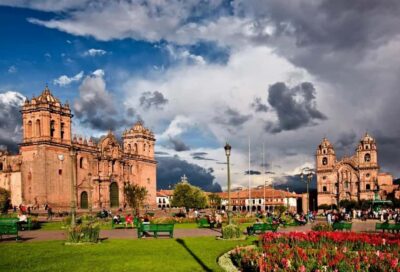
City Tour Cusco Qoricancha Sacsayhuaman y Tambomachay
Read our review →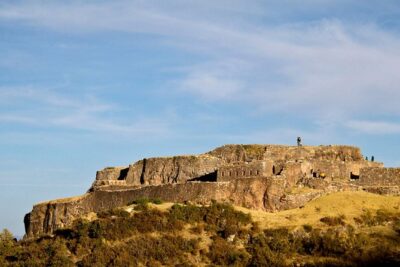
Pachacamac Ruins & Barranco Half-Day Guided Tour
Read our review →
Pre Inca Temple of Pachacamac Half-Day Tour from Lima
Read our review →
Tour to the Archaeological Sanctuary of Pachacamac (small group)
Read our review →
From Pyramids & Bohemian Streets: Lima Miraflores & Barranco Tour
Read our review →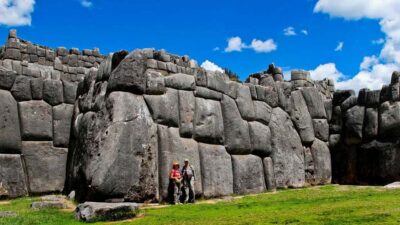
City Tour | Half-Day Tour to 4 Archaeological Sites
Read our review →Browse the lists this tour appears in